Saturday, March 10, 2012

Recording of the Week


Do you really need another set of the Beethoven symphonies? I was skeptical too, I admit, but if it's this recent release of the live recordings made by the Vienna Philharmonic under Christian Thielemann from 2008 through 2010, you might just. The recordings have been released already in DVD and Blu-Ray formats in 2011, but Sony has put together this single set now for those not inclined towards high end home theater systems.

Poor Beethoven. You'd think the most famous name in music had fallen upon the hardest of times. His music apparently now requires entire months of radio programming to convince people to appreciate it. Concert programmers as recently as last week were still trying to explain why his music even matters. How things got this bad for the old man are unclear. But listening to a recording as good as the Vienna Philharmonic's recent symphony cycle under Christian Thielemmann reinforces how inane this kind of marketing blather is. These performances do all the explaining anyone could need.

These are big-boned Romantic performances that make the most of the Vienna players' polished, exacting sound. It's almost as if Harnoncourt never happened. But this sort of fleshy Beethoven, popular half a century ago never really went away on world stages, and Thielemann taps into this with interpretations that are bright sounding, and often muscular. There is nothing retro about this work, however, and the symphonies sound as fresh and lively as ever. Thielemann has a strong sense of dynamics and pushes tempi in both directions but never to the point of losing the bigger picture.

And if you are looking for an argument for why buying physical recordings still matter, this is it. A digital download may be infinitely more portable, but it isn't as much fun to peruse as this white, cloth-bound set with individual paper sleeves for the discs. It's a lovely set and includes a bonus DVD with interviews and excerpts from the DVD releases as well. Help yourself. You need an Easter gift.

Friday, March 9, 2012

Abner Jay: The Last Southern Black Minstrel Show

Abner Jay, April 8, 1982, San Jose Flea Market; selection of a photo by Jon Sievert

[Editor's Note: As I am facing numerous writing deadlines, this seems like a good time to give a retrospective glance to the first two years of Art of the Rural. Over these weeks I will feature a few new articles, but also many favorites from the archives. Thanks again to everyone who has read and contributed; what began as a labor of love has become a project far larger, and far more rewarding, than I ever could have anticipated - and I deeply appreciate the readership and participation of such a diverse audience. Starting March 19th, we will offer new articles and share some new projects related to our mission.

Abner Jay: The Last Southern Black Minstrel Show was originally published on March 3, 2011.]
 
**********
 
In this post, and the previous post below, we're considering the life and music of Abner Jay--a figure whose art cuts across so many themes central to the American experience: race, class, regionalism, history, and place. Mississippi Records has just released Mr. Jay's final recordings, entitled Last Ole Minstrel Man.

I've heard from a number of folks in the two days since the previous post, readers who have been bowled over the emotion, creativity and cultural import of Mr. Jay's work. Today I'd like to share more information and links. Beyond that, the best thing to do is to sit down with his records, turn off the phone, and just listen.

Abner Jay was born in Fitzgerald, Georgia in 1921, into a family of sharecroppers. Though various internet sites tell the story slightly differently, Mr. Jay's grandfather--and perhaps his father--had been slaves. The legal terminology, however, is of less import than the realities of those early years of his life. Amoeba Records' blog offers a generous transcription (from the current release's liner notes) of Mr. Jay's own recollection of this time period:
"Abner was a slave sixty five years after the slaves were freed, because Abner grandpa and Pa love the slave life. Abner was hired out to white plantation owners when he was at the age of six. Abner worked as a slave side by side with his grandpa, a former slave. Abner could not and did not receive his pay until after he was twenty one years of age. Abner ate and slept in the barn with the mules. The White folk would hand his food out of the back door to him in a pan, mostly left overs and the food the white folk dogs wouldn't eat...

"Abner start singing on the public for the white plantation owner when he was eight. Abner start playing banjo at the age of ten, and became a one man band and bone player at the age of fourteen. Abner would play in the rich homes for the plantation owners when they wanted to entertain."
Mr. Jay later toured with minstrel and vaudeville shows, eventually striking out as a young man on his own--a one man band. Along the way he became friends with Muddy Waters, Chuck Berry, James Brown and, according to some sources, Elvis. He was also the agent and manager to the phenomenal gospel singer Sister Rosetta Tharpe. In the final decades of his life, Mr. Jay traveled from town to town in a mobile home that could convert into a performance stage

Again, Chris Campion so clearly articulates the many attributes of the sound that might surprise attendees of a local fair or flea market:
Jay finger-picked a bittersweet but heartfelt comic blues on a long-necked, six-string banjo that he said had been made in 1748. It had been passed down to him by his grandfather, Louis W Jay, born a slave and later to teach Abner many of the traditions he made it his mission to keep alive.

He was almost certainly the last living exponent of the 'bones' - a musical tradition that involved playing percussive rhythms using various cow and chicken bones that had been dried out and blanched in the sun. Jay claimed to have a repertoire of over 600 songs, which he sung in a bone-shaking basso profundo voice, the legacy of a battle with throat cancer that almost felled him in his twenties.
He would perform field songs, minstrel tunes and Pentecostal hymns interspersed with his own nuggets of homespun philosophy, off-colour yarns and side-splitting one-liners. 'What did Adam and Eve do in the Garden?' runs one. 'Eve wore a fig leaf... and Adam wore a damn hole in it.'

Jay's own compositions were decidedly secular in nature and found him musing on atypical themes such as depression, the Vietnam war and substance abuse. Titles include 'The Reason Why Young People Use Drugs' and 'The Backbone of America is a Mule and Cotton'. 'I crave cocaine,' he moaned during crowd favourite 'Cocaine Blues', exaggerating his diction for comic effect. 'But I can't find nothing here in Atlanta. Cos those hippies dun used it all up... I want sum'tin to pep me up!'
For more information,  The Down Home Radio Show features Eli Smith's interview with Eric Isaacson of Mississippi Records; the two discuss the label's release of The True Story of Abner Jay as well as the true story of the record label itself, which has become a faithful steward of many later Abner Jay re-issues.

Here's a rare gem: an excerpt from Mr. Jay's final performance at the 1993 Grassroots Festival in Trumansburg, New York. We see in this personal rendition of "St. James Infirmary Blues" what Mr. Isaacson means when he says that people called Abner Jay "the black Bob Dylan." Even more forcefully than Dylan, Abner Jay stood with one foot in a lost, folkloric America and the other in the ground of rock 'n' roll, radio, and television. The great achievement of his music is that these contradictions are fused together in ways that can be  both deeply-moving and profoundly unique.  

We learn that he passed away days later, on his way back home.


**********

selection from the cover of Mississippi Records' recent Abner Jay release

Folk music is high class music--of course a lot of low class people singin' it. Matter of fact, most so-called folk singers don't even look like folk. Folk songs tell true stories, but terrible stories--'cause folk are terrible. Terrible songs make big songs. Why do you think kids like rock 'n' roll ? Because it's terrible. You think they're gonna listen to the Philadelphia Symphony, 101 Strings? Why do you think I like cocaine?

Tomorrow we will write more extensively about Abner Jay (1921-1996), a multifaceted musician and artist--and the self-proclaimed "last great Southern black minstrel show." His music (and his life story) was complicated and unconventional, but also singularly brilliant. 

Here Chris Campion of the Guardian writes of Mr. Jay:
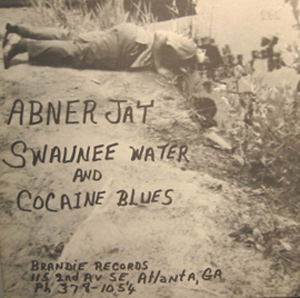
Rather than cocaine, he used to claim that the secret of his eternal youth and vitality was lying on his belly drinking water scooped out of the Suwannee River in his home state of Georgia. And at least two of his albums (privately-pressed and released on his label Brandie, named after his wife) feature a photograph of him doing just that, along with the tracklisting, which he customarily scrawled over it in marker pen.

Jay was himself born near the source of one of the tributaries of the river in Irwin County, Georgia (in 1921). He started performing in medicine shows at the age of 5. In 1932 he moved on, to the Silas Green show, a travelling minstrel show and vaudeville revue that had also once employed Bessie Smith. Aged 14, he became a one-man band.
Enjoy these two selections from The True Story of Abner Jay, an earlier record re-released by Mississippi Records:


Thursday, March 8, 2012

Responding To The Kansas Arts Veto

Kansas Governor Brownback signing the 2012 state budget; John Hanna

[Editor's Note: As I am facing numerous writing deadlines, this seems like a good time to give a retrospective glance to the first two years of Art of the Rural. Over these weeks I will feature a few new articles, but also many favorites from the archives. Thanks again to everyone who has read and contributed; what began as a labor of love has become a project far larger, and far more rewarding, than I ever could have anticipated - and I deeply appreciate the readership and participation of such a diverse audience. Starting March 19th, we will offer new articles and share some new projects related to our mission.

Responding To The Kansas Arts Veto was originally published on June 21, 2011. To learn more about how national foundations only give 1% of their funds to rural America, please see our article here.]
**********
  
As many of our readers have heard, Kansas Governor Sam Brownback used the power of his line-item veto to erase funding for the Kansas Arts Commission from the 2012 state budget, a move that effectively shut down the organization and fired its staff. By deleting this state-sponsored entity, Governor Brownback also shut the door on matching funds The National Endowment for the Arts would have granted to the Kansas Arts Commission. 

Today we'd like to offer some viewpoints and commentary on this issue and its devastating repercussions for rural communities. We'll begin with this recent NPR report by Elizabeth Blair, aired on Morning Edition last week. Ms. Blair's piece is an excellent introduction to this debate, and to the contrary opinions by some in the arts community that suggest private funding would be a more effective and more liberating avenue. Below is an excerpt:
Private dollars have been really good for the Topeka Civic Theatre and Academy where Shannon Reilly is artistic director. The company is celebrating its 75th year. "Through most of that history we've been funded solely through ticket revenue, donors and corporate support," Reilly says.
Reilly says for the most part, they have avoided government grants and that has worked to their advantage. "More and more I've seen that arts organizations ... receiving tax dollars were constantly under fire about their programming and what they were doing," Reilly explains. "I like being responsible to my donors and to the people who were investing in what were doing more than a larger tax base."
While this model is certainly attractive, only at the close of her piece does Ms. Blair allow for this harsh reality: private funding for the arts is likely to replace (or exceed) public funding only in urban areas. We can turn to this Kansas Citizens for the Arts press release for further analysis of the rural dimension to Governor Brownback's arts veto: 
“With a stroke of his pen, the governor cost the State of Kansas $1.2 million,” said Henry Schwaller, chairman of the Kansas Arts Commission. “On July 1, nearly 200 local arts organizations and artists will lose critical support for local arts programs, operational funding and professional development. Without this support, jobs in the arts are at risk, and artists and arts organizations will lose the important infrastructure that has been created largely because of the funding and expertise of the Kansas Arts Commission.
Kansas Arts Commission grants were crucial to many organizations, particularly those in rural areas. If an organization received funds from the Kansas Arts Commission, donors were more likely to contribute to that organization, which leveraged additional dollars for the organization and its community. Because few foundation or corporate donors provide money for operations, the Kansas Arts Commission’s main grant program, Operational Support, was an important way organizations covered general expenses such as rent, utilities and salaries. Many organizations, particularly those in rural or impoverished areas, will find it difficult to replace the lost state and federal funds and will either restrict or eliminate important community programs, cut staff or close their doors.
The horrible irony here is that Governor Brownback's veto will disproportionately affect the life of the rural communities from which he has drawn overwhelming political support. His gambit overlays a national "culture wars" argument on the local arts programming in towns far removed from urban centers.  As The Kansas City Star writes in a recent editorial, Governor Brownback is "hoping to make points with conservatives nationally," while ignoring the local and regional dynamics:
As was the case with Brownback’s misguided attack on public broadcasting, he’s applying a national conservative cause to his home state, without considering the damaging impact on rural areas. Public broadcasting provides one of the only sources of news and information in the sparsely populated western half of the state. Urban areas, the target of this notion, have other options and can replace public funding. The elimination of public arts funding, again, isn’t likely to hurt the Kansas City area as much as Lincoln County, Kan.
As rural developers know well, while technology makes it possible to create new business in the high plains, new business will consider quality of life as much, perhaps more, than tax advantages. Brownback has handed surrounding states an effective tool to beat Kansas communities looking to attract doctors and needed professionals.
In the space of this site, we've tried to document and also to complicate the notion of "the rural arts," but Governor Brownback's arts veto sets a giant and unmistakable corrective in the midst of this project. While we can turn to The Daily Yonder and The Rural Blog for their excellent and consistent coverage toward defining what's at stake in the organizing "rural" moniker, there's another dimension to the other half, the "arts" definition, that we at The Art of the Rural have been perhaps slow to cover--and it lurks beneath the articles excerpted above.

This would be the irreducible political element, voluntary or not, that always coheres around the reception of the rural arts. What we find here is an amalgamation of regional assumptions, as well as preconceived notions about the "place" of the arts; in many respects it's a remnant of the politically polarizing climate of post-9/11 America. To return to the dreaded red-state/blue-state mindset (as I intimately learned while living in Boston), a great deal of people from the larger urban and suburban centers of America implicitly view arts-making as a "blue state" activity, complete with its own ideologies and politics.

What the Kansas arts veto makes abundantly clear is that even some public leaders from the interior of this country--despite a wealth of evidence beneath their noses--have refused to challenge this cultural orthodoxy, despite how reductive and just plain-wrong it might be. This is not a Republican vs. Democrat or conservative vs. liberal argument, but a case of recognizing that the arts are vital to all communities, and that they can speak for a range of viewpoints and cultural histories beyond the boogey-men of Robert Maplethorpe nudes or Chris Ofili elephant dung paintings.

In turn, those of us making art and working to ensure its reception need to continue to stress its "site specific" nature, and we need to welcome work which challenges our own political and cultural orthodoxies. 

In closing, we will offer an excerpt from last weekend's Kansas City Star editorial by Joyce DiDonato, arguably the most acclaimed opera singer in contemporary classical music. Born in Prairie Village, Kansas, Ms. DiDonato has spoken up for her home state in interviews around the world, and in the press following her award of the illustrious Gramophone "Artist of the Year" in 201o. (Her broken-leg performance of The Barber of Seville has become the stuff of opera legend.) 

Here is an excerpt from Ms. Didonato's eloquent response to Governor Brownback's decision:
This is the Sunflower State that I have proudly boasted about across the world, fearlessly defending it even in the face of harsh quizzical looks from the most skeptical of folks (“You live where?”). It’s the state of my first piano recital and choir concert. The home field of my artistic curiosity and education. The homeland that taught me to freely dream big and without limitation; one where the arts were once alive, vibrant and supported.

I’ve welcomed the assumption of being an unsolicited but mightily proud artistic ambassador for Kansas to the great cities of the world. Now, for the first time, I feel shame. Eliminating a state arts commission is an ignorant, short-sighted, fearful and unspeakably damaging act to the spirit and soul of this great state.

I’m not a politician or historian. I’m a humble opera singer, a home-grown product of an agricultural state that used to value the arts, like all great societies and cultures of the past. But my anger rivals a good ol’ western Kansas Category 5 tornado’s destructive force when I begin to think of where I’d be without an education fueled by the arts that informed my way of thinking. Or without a community theater, choir or art exhibit that gave me true solace and an emergency exit from some of the great crises in my life. Or without that musical outlet that helped me understand myself and the mystery of life a little better.

No One Gets Away Clean

The cast of Ricano's Timboctou Photo: Steven Gunther 2012
Hot on the heels of one big ambitious Spanish-language theater production at REDCAT comes another. Timbotou, a world premiere production developed in a collaboration between the CalArts Center for New Performance and the University of Guadalajara Foundation, takes its constituent parts from materials much closer to home, though. The play written by Alejandro Ricano and directed by Martin Acosta, like its cast and creative team, lies on the border between the U.S. and Mexico, incorporating elements from communities on either side of this imaginary division of space into a vision that emphasizes the inter-relatedness of all its elements. Acosta and his design team have created an arch, visually compelling world that shoots for some ideological heights even if the bare knuckle storytelling in the two hour intermission-less performance is frequently far more pedestrian and earth bound.

Timboctou refers to an imagined place, the one farthest from wherever its characters are at any given time, that would provide escape from the particular stressors or crises at hand. And there’s a lot of the world the characters in this world would want to get away from including drug trafficking, government corruption, global warming and murder. The play is episodic and focuses on several sets of loosely interrelated characters, whether enacting or coping with the consequences of various illegal activities. Dany, played by Mario Montano Mora, and his twin Chucho, an equally humorous Axel Garcia, open the play trying to dump the corpses of several murder victims in the parking lot of a McDonald’s restaurant in Tijuana. Their highly choreographed movements stand in contrast to the darkly comic banalities of their debates about the spelling of “sabes” in a warning note to accompany the bodies they are to dispose of.

Axel Garcia and Mario Montano Mora Photo: Steven Gunther 2012
The tone here sharply emulates the kind of banter Quentin Tarantino’s entire career is based on, and Ricano’s script is funny if far less sharp and effective than that. Soon the story spins into various directions looking at closely related plots that impinge on Dany and Chucho’s world including the visiting Spaniard they meet earlier in their travels and later the vacationing San Francisco college students who will accidentally kill him during a drunken beach brawl. It’s a structure that calls to mind another film, Steven Soderbergh’s Traffic with its network of lives created and destroyed by the illegal drug industry. There are comical, incompetent government officials, stiff DEA agents, and mourning family members that populate Timboctou. Some of their vignettes work better than others but all share the same gabby, comical tone.

Timboctou, which is mostly in Spanish and uses projected supertitles on the walls of the set, is at its best when it unhinges itself from all this wordplay and runs with the surreal imagery that fills its physical space. The set is dominated by a mountain of rusty office chairs that at one point takes off in motion and becomes a shifting metaphor for a number of issues in the play. There’s use of performance generated video feed which is fed into a small monitor suspended from the ceiling throughout most of the performance. The stylized choreography of the opening scene remains consistent over the show's running time as well. There are also repeated references and visual projections of polar bears, creatures that Dany and Chucho imbue as inhabitants of the world farthest from them, but one still endangered by the global warming destroying their habitat. The twins see themselves in these endangered animals struggling in an increasingly hostile habitat. Later the bears actually arrive and dance to Handel’s “Lascia ch’io pianga”, an aria best known for its use in the 1711 opera Rinaldo.

Ricano and Acosta have an eye for the absurd and a visual language to go along with it. There’s power in Timboctou that suggests the show has something to say and places to go. But the evening still wants for more consistency and a looser, less narratively driven structure, which tends to dilute and reduce the power of its impact. Still the show offers a lot to think about and represents REDCAT’s commitment to theater events without any other comparable home in town. The show runs through Sunday the 11th downtown.

Tuesday, March 6, 2012

In the Wings - Mar '12

Timothy Andres
OWA is back from the recent cold and snow on the East Coast to sunny everyday Los Angeles and looking forward to a busy March. What to do? Here’s my list for the picks of this month in performing arts around town and beyond. Interestingly the two events I’m most anticipating involve composer Timothy Andres who has been seen on local stages before and will be all over the place at the end of the month. He’s one of a number of young composers whose music will be featured in the latest program from wildUp, entitled “Craft” on the 23rd and the 24th. Director Christopher Rountree and his fellow young musicians have selected a program riffing on the contrast (or lack thereof) between East and West coast composers programming them side by side for these evenings at Beyond Baroque in Venice. Meanwhile, Anders will unveil a major new piano concerto commission entitled Old Keys for the Los Angeles Chamber Orchestra as part of their Sound Investment commissioning project on the 24th and 25th. And just to cap off LACO’s big month on the 7th, music director Jeffrey Kahane and his players will celebrate his 15th anniversary with the group in a concert at Walt Disney Concert Hall.

Frances-Marie Uitti Photo: Francesca d'Aloja
Probably the other major musical event this month will be the inaugural Piatigorsky International Cello Festival that will welcome over two dozen cellists from around the world for two weeks worth of concerts, master classes, and other events in a large collaboration between LACO, the L.A. Philharmonic, and the Colburn and Thornton Music Schools. There’s a lot to choose from including performances from Mischa Maisky (17th), Alisa Weilerstein (18th), and Ralph Kirschbaum (15th) with the L.A. Philharmonic under Neeme Järvi (a different work and soloist is featured in each program.) There are also two group shows worth checking out including a performance of all six of Bach’s unaccompanied Cello Suites with 6 different soloists on the 11th and another program that closes the festival on Sunday the 18th at WDCH featuring music by Adès, Stravinsky, Bach, Rachmaninoff and others played by 9 different soloists. And speaking of internationally known cellists, REDCAT will welcome Frances-Marie Uitti for a program of late 20th century works in a rare L.A. appearance on the 23rd.

Jessye Norman Photo: Carol Friedman
Of course if you want 20th century music there are other opportunities to consider. The Southwest Chamber Music collective will continue its John Cage 2012 festival with programs on the 3rd, 4th, 10th, 11th and 24th all around town covering a wide variety of the composers works in his centenary year. Monday Evening Concerts will offer avant-garde works on the border between jazz and everything else in a program including works by Peter Ablinger and Stefan Wolpe on the 26th. Also at REDCAT this month will be another adventurous evening from the California E.A.R. unit who'll collaborate on the works of Morton Subotnick on the 24th. Meanwhile, there's plenty to see in San Francisco where Michael Tilson Thomas will lead two weeks of American 20th century music as part of the wide ranging “American Maverics” festival which will repeat at Carnegie Hall later this season. Music by Harbison, Ives, Foss, John Cage and others will be performed by the likes of Jessey Norman, Joan La Barbara, and Meredith Monk who will collaborate on selections from Cage's Song Books on the 10th. The SFS has created a festival pass as well that can get you into the shows for relatively little and it breaks my heart that I’ll only get to see the shows on the 9th and 10th but there are many other worthwhile events including an appearance by the PARTCH ensemble on the 11th.

There’s other music of course. The L.A. Philharmonic will offer a program with Osmo Vänskä leading Sibelius 6th symphony on the weekend of the 23rd. Ute Lemper and the Vogler Quartet will grace UCLA’s Royce Hall on the 29th with more early 20th century cabaret music. And as we head into April the Los Angeles Master Chorale will perform Bach’s St. John’s Passion on the the 31st and April 1st at WDCH. The Philharmonic Society of Orange County will welcome three big guest ensembles including the St. Petersburg State Symphony Orchestra on the 13th, the Takács Quartet with Garrick Ohlsson on the 20th and Marin Alsop with the Baltimore Symphony Orchestra on the 28th. And there will be two major opera openings in the region with San Diego Opera reviving Donizetti’s Don Pasquale starring Danielle de Niese and Charles Castronovo on the 10th and Long Beach Opera offering a puckish 20th century comedy double bill with Poulenc’s The Breasts of Tiresias and Martinu’s The Tears of a Knife on the 11th and 17th. (Castronovo will also give recitals in Orange County on the 30th and April 1st.)

from Ballet Preljocaj's Snow White Photo: JC Carbonne
On the theater front, Pasadena’s A Noise Within will offer two new productions. First up will be Shakespeare’s Antony and Cleopatra starting on the 3rd which will be followed on the 17th with Tony Kushner’s adaptation of Corneille's The Illusion. REDCAT will present the world premiere of a new work from Martin Acosta called Timboctou starting on the 3rd. Dance at the Music Center will host visits from Evidence starting on the 9th and Ballet Preljocaj who will give three performances of their highly regarded production of Snow White the 23rd through the 25th. The Center Theater Group will have new shows in all of their houses including the Green Day musical American Idiot at the Ahmanson starting on the 13th, Beckett’s evergreen Waiting for Godot at the Mark Taper Forum on the 14th, and on the 9th at the Kirk Douglas Theater the excellent American Night, a comedy from L.A.'s own Culture Clash that received its premiere at the Oregon Shakespeare Festival in 2010. And speaking of OSF, I’ll be reporting on some of their early productions for the year as the month closes including Mary Zimmerman’s staging of The White Snake but will share more on their great season a bit later on. Down in San Diego the Old Globe has productions of O'Neill's Anna Christie to consider on the 15th and a new musical version of A Room with a View from the 2nd. And don't forget South Coast Repertory's latest revival of Donald Margulies Sight Unseen which starts on the 11th. And won't you please go see Ms. Sandra Bernhard as she returns to the area at La Jolla Playhouse from March 14 - 17. Of course there's plenty more so stay tuned for further detail as the month goes along and always check out the calendar section for selected upcoming events.

Monday, March 5, 2012

A Naked Boxer on the Royal Way


The thing about writing on the work of Calixto Bieito is that it puts one in the position of writing about things one normally wouldn’t in polite company. Things like anal sex. And in case you’re wondering there’s that and plenty more where it came from in Bieito’s American directorial debut, a new adaptation of Tennessee Williams’ Camino Real opening at The Goodman Theater in Chicago! which I saw in a preview last weekend. (Yes, I know that Bieito directed a touring production that was featured at BAM in the late 90s, but this is new original work specifically for the U.S.) Bieito, for the uninitiated is the undisputed emperor of shock-tactics opera throughout Europe, which of course makes him public enemy number one for American opera companies who’ve used his work, albeit through indirect references, as a marketing and fundraising tool in this country. (“You know we're doing a good job running this opera company because we’re NOT ALLOWING THAT EUROPEAN STUFF TO HAPPEN HERE!”) But opera audiences are an awfully easy group to shock, so the Goodman’s Robert Falls thought now might be the time to invite Mr. Bieito to the U.S.

After some discussion, the two settled on Williams’ late, poetic and controversial flop about the dead-end of 20th-century American culture. Williams’ original play concerns an American boxer named Kilroy who finds himself stranded in an anonymous Latin American desert along the Camino Real. The pronunciation is deliberately anglicized and often shifting throughout the course of the work. The local resort, the Siete Mares, is populated with a variety of famous literary characters who have also come to the end of the road inside Williams' own imagination including Lord Byron, Marguerite Gautier, Cassanova, Esmerelda and Don Quixote. Williams’ play eschews narrative for poetic dreamlike sequences, which could be seen as a precursor to anything David Lynch has ever bothered to put on film. Enter Bieito and his writing collaborator Marc Rosich who elected to largely rework the play dropping scenes and dialog and replacing them with Williams’ words from other places and his own embellishments to give the show a unique perspective on this most American of plays.

So what do you get? As it turns out nearly two uninterrupted hours of fascinating if no less elliptical conjecture about a culture, if not a world, winding down and crumbling in on itself. The first thing that should be said about the piece is how absolutely fantastic it looks. The show is operatic in scope with one arresting visual sequence after another. There's a sky full of neon lit signs, a sea of police lights, and multiple spinning mirror balls. All of this transpires on a empty black stage backed with a multi-panel chain-link fence. It looks as modern as can be, and the entire 13-member cast stays on stage most of the time, each in their own unique little world. Of course, the drama comes from how these little worlds collide, which they do repeatedly often with graphic results. Some get shot, others have their heart cut from their chest. Virtually everyone is sexually humiliated at some point. All of this was absorbed by Sunday’s audience with apparent ease.

But that doesn’t mean the overall story goes down easily. The evening begins with Don Quixote, who Bieito dresses as Williams himself, stumbling onto the stage disheveled, drink in hand, pulling his roll-aboard luggage. He drinks and throws up several times, finally guzzling down a bottle of pills to fall off to sleep. The play is mostly his dream of the Camino Real, which is not unlike the Eagles' Hotel California, you can check out any time you like, but you can never leave. Though several characters do try along the way. There is a sort of mayor character named Gutman modeled after Sydney Greestreet's character in The Maltese Falcon and a police officer who serve to remind everyone else of their fate in the off chance they begin to forget. The show is littered with musical performances often sung by a blind woman, La Madrecita de los Perdidos, in intentionally anglicized Spanish. There’s a powerful number André De Shilds dressed as Baron de Charlus sings a version of Screamin’ Jay Hawkins’ "I Put a Spell On You" amid a crowded stage of luggage abandoned during false escape attempts. Kilroy, the boxer, whom we later find out is not quite the champion we thought, arrives and is soon sucked into the events as much of his clothing is lost. While there is not actual nudity in the show, a Bieito staple on the opera stage, there is still plenty of flesh on display and the ungroped crotch in this performance is a rarity.

But most intriguing about the show is how much Bieito shifts the focus away from Kilroy in favor of the resort's famous and infamous inhabitants. Most of these legendary visitors are in fact Europeans, and once Kilroy has been side-lined as a patsy, they more or less work on chewing each other up and spitting each other out. While the tragedy of the piece does come back around to the boxer in the end, Bieito’s take on things came off to me as a globalizing gesture. America both loved and reviled for its domination of world culture, has run out of options and now waits as a sacrificial lamb to the world it has helped create. Just as the days of Yankee imperialism aren’t what they used to be, the critique of the bankruptcy of American culture has become a critique of a global one.

The show is funny, often seriously so, and the ensemble cast is uniformly excellent having made total commitments to this abstract, sometimes dark vision of the inside of a particular artistic mind. I won't name them all here, but you should go experience all the performances first hand. And while it's not an edge-of-your-seat thriller, Bieito's thoughtful multi-layered text on an already abstract work left me wanting to see it again right away. It runs in Chicago through April 8.

The Legend of Cas Walker

 The Cas Walker Knoxville city council fist-fight; LIFE Magazine

[Editor's Note: As I am facing numerous writing deadlines, this seems like a good time to give a retrospective glance to the first two years of Art of the Rural. Over these weeks I will feature a few new articles, but also many favorites from the archives. Thanks again to everyone who has read and contributed; what began as a labor of love has become a project far larger, and far more rewarding, than I ever could have anticipated - and I deeply appreciate the readership and participation of such a diverse audience. Starting March 12th, we will offer new articles and share some new projects related to our mission.

The Legend of Cas Walker was originally published on April 11, 2011.]
 
**********

I recently received an email and suggestion from Chuck Shuford, a writer and arts commentator for The Daily Yonder and a number of other publications. I think that many of our readers will be interested in this: the life and times and televised work of Cas Walker (1902-1998). Here's an excerpt from Mr. Shuford's correspondence:
My friend sent me a link to Cas Walker pontificating on his early morning TV program -- this was probably sometime in the 70's.   You need to know about Cas.  He owned a chain of grocery stores in E.TN, E. Ky, and SW Va.  He was also a politician, serving on the Knoxville City Council where he got in a fist fight at least once with a councilman holding a contrarian view.  He was elected Mayor of Knoxville and then very soon after, recalled.  He then ran for council again successfully until he retired in the early 70's. If god ever made an ornerier man, I've been hard to come by him.  As someone once said "If I ordered a car load of SOB's and they only sent Cas, I'd sign for it."  Dolly Parton and the Everly Brothers sang on his show as youngun's.   His home, which he lived in until his death, is about 3 blocks from our home.  Ironically, it is now owned by a lefty UT professor who recently wrote a book on Eugene V. Debs.
Writing in the Knoxville Metro Pulse, Betty Bean reveals how this "Hillbilly Collosus" also possessed an ability to manipulate media and technology:  
Cas had served on City Council longer than I’d been alive, and had been among the first to grasp the power of television not only for selling stuff but for fighting off fluoridation, metro government, bad check writers, shoplifters, dog thieves, civic improvements of any sort, and police officers who hung around and drank coffee in establishments other than his own.


YouTube offers a small selection of Cas Walker Farm and Home Hour clips, including one of the Dolly Parton performances Mr. Shuford alludes to above. Is that Waylon Jennings playing on the right of the screen?


Cas Walker's life is impossible to summarize in just a few paragraphs, so please refer to this lively and surprising feature by Ms. Bean in the Metro Pulse. Mr. Walker's ascension to millionaire grocery magnate is marked by a rough, self-conscious transition from rural to urban life--and a hatred (an accurate word in this case) for "the silk-stocking crowd" who taunted him during his youth. While he had a combative sense of class, and an equally combative political sense, even those who opposed him in these regards were charmed and even awe-struck by the stubborn creativity Mr. Walker channeled into The Farm and Home Hour and his grocery store promotions.

Ms. Bean writes extensively of one of Mr. Walker's most legendary exploits, when he buried local character Digger O'Dell alive for multiple weeks, just to generate increased sales at this grocery stores:
"He [Digger O'Dell] said 'I will be buried, six feet underground, with a stovepipe running down to where I am so people can talk to me.' I [Cas Walker] said, 'What do you get for that kind of work?'"
He said "I get $100 a day.'
"I said 'I was thinking about offering you $25 a day, but I am going to offer you $50.' His wife was a Jewish woman and she was shaking her head yes so I knew I was going to start burying a man and I had never had that experience before.
"We dug our hole, and I got ready to bury him. Of course, I advertised that I was going to bury him at a certain time. You never seen a crowd like we had."
Digger had a telephone, and Walker remembers that he "talked with women all night. You have never experienced a ladies man such as this one was."
Walker put up a tent over Odell's grave to accommodate the crowd, which one night numbered 1,500 at 2 a.m.
But Digger wanted to be dug up before he had fulfilled his 30-day contract. Walker was having none of it, since daily receipts at the Chapman Highway store had increased from $3,500 to $8,000.
"I told him that was too much money to dig up," Walker said in a 1990 interview with the Knoxville Journal.
Digger started faking heart attacks and calling the newspapers and the health department to complain that Walker was denying him medical care.
Walker's solution was to dress two women who worked for him in "nurse suits" and station them above the grave, selling barbecued chicken sandwiches.
Knoxviews offers a brief write-up of these stunts (including the LIFE Magazine fist-fight)--make sure to read the comments section, as many local folks contributed their own memories of Cas Walker.

The Tennessee Archive of Moving Image and Sound also houses many of the historical Cas Walker commercials and Farm and Home Hour tapes. TAMIS deserves its own post here on the The Art of the Rural, and that will be forthcoming, but, until then here is one of the archival commercials:


The Museum of Appalachia also features John Rice Irwin remembering Mr. Walker and his love for Coon Hunting.