Showing posts with label south. Show all posts

Wednesday, March 14, 2012

David Lee, Carolina Soul & The Paradise of Bachelors Record Label

David Lee with the Washington Sound record shop sign, in front of his storage trailer;  

[Editor's Note: As I am facing numerous writing deadlines, this seems like a good time to give a retrospective glance to the first two years of Art of the Rural. Over these weeks I will feature a few new articles, but also many favorites from the archives. Thanks again to everyone who has read and contributed; what began as a labor of love has become a project far larger, and far more rewarding, than I ever could have anticipated - and I deeply appreciate the readership and participation of such a diverse audience. Starting March 19th, we will offer new articles and share some new projects related to our mission.

David Lee's Carolina Soul was originally published on August 2, 2011.]

********** 

Long-time readers might remember our piece from last year on the Carolina Soul site and the Paradise of Bachelors record label. POB's first release, Said I Had A Vision: Songs & Labels of David Lee 1960 - 1988 was one of our absolute favorite records from 2010--and the release has continued to get some wonderful press, so I'd like to start off the week by sharing some of this information. If we've hit the summer doldrums (August), this record is the best antidote I can imagine. Paradise of Bachelors is now offering a limited edition LP repressing; folks can find the digital download at iTunes or Amazon Music. 

Here's "You've Been Gone Too Long" by Ann Sexton. As the liner notes explain, "the tune must make any list of curious, 'Jody' genre songs, for its reference to the archetypal male opportunist who, according to Vietnam-era folklore, would latch onto women whose husbands or boyfriends were serving overseas." 


While we are currently in a golden age of reissues and unearthed music, with more and more coming out each week, what sets Said I Had a Vision apart is its combination of context (rural North Carolina, from the civil rights era to the Reagan era), the  quality of its songwriting, and the absolute exuberance of the performances. Many such records have these qualities in unequal parts, but Said I Had A Vision contains songs that exceed the normal obscurity-fetish that similar records often cultivate. After I play this record through, I generally feel like everyone I know needs to hear these songs.

It should be no surprise, then, that the music press has embraced this record and the regional vision behind the Paradise of Bachelors label, which is co-curated by folklorists Jason Perlmutter and Brendan Greaves. I was excited to learn that Wax Poetics had featured Said I Had a Vision in a recent issue; here's Jon Kirby:
A man of faith, [David] Lee's output tended towards the spiritual. And although most benefit from Cleveland County's proximity to Charlotte's Arthur Smith and Reflection Studios, perhaps his most generous offering was recorded on location at Mice Creek Baptist Church, in nearby Gaffney, South Carolina. "On My Way Up" by the Relations Gospel Singers showcases the careening lead of Steve Allen, whose exorcism range leaves church-van tracks through a field of delicate piano and choral support, recalling the fly-on-the-wall intimacy of an Allan Lomax artifact. Much of Lee's color-blind songwriting was realized by the Constellations, a salt-and-pepper ensemble who, during Shelby's annual Art of Sound Festival last October, proved they could still do "The Frog," walking sticks in hand. "They were just like kids to us when they started," revealed wife Nelena of Lee's most allegiant act. "We was just like a big family, rolled up together." With the exception of "northern soul" curiosity Ann Sexton, most on Lee's short-but-sweet roster still reside in Cleveland County, like blue-eyed crooner Bill Allen from nearby Cherryville. "You probably drove past there!" exclaims Lee. "You should have hollered for Bill when you was coming through." 
Further write-ups on the resurgence of interest in Mr. Lee's work has appeared in Our State magazine and The Charlotte Observer. Earlier this year, Mr. Lee was awarded the Brown-Hudson award by the North Carolina Folklore Society, introduced by Mr. Perlmutter and Mr. Greaves. Afterwards, he gave a performance of "I Can't Believe You're Gone" and "I'll Never Get Over Losing You," the latter of which appears on Said I Had a Vision: 


Paradise of Bachelors will release an LP/download of new material emerging from the South this fall: Poor Moon by the much-loved and critically-acclaimed Hiss Golden Messenger. Also in the works is a release of new and remastered material by Willie French Lowery, a member of the Lumbee Tribe in North Carolina and who has worked previously with the psychedelic bands Plant & See and Lumbee. I'll include a sample of each artist below; you can also follow the latest Paradise of Bachelors news on their Facebook page.


Hiss Golden Messenger from Gianmarco Del Re on Vimeo.


**********

[Discovering Carolina Soul was originally published on September 23, 2010]

The former Washington Sound on Buffalo Street in Shelby, NC; from Carolina Soul

Throughout the sixties and seventies, at least one hundred African-American-owned R&B/Soul record stores thrived in the Carolinas. These retail shops, with their close links to recording studios and local record labels, were on the front lines not only of new musical ideas, but of the civil rights struggle itself. Today, this music's story is being told in a compelling fashion on the Carolina Soul blog/archive, which has spent the last five years locating and documenting the wide array of R&B/Soul music created in North and South Carolina--much of which has never been re-issued since its original release as 45 rpm records.

If you peruse Carolina Soul's extensive discography the material object of the vinyl record begins to stand as a symbol for a kind of rural-urban linkages that revolutionized the last half-century's artforms and its push toward social justice.  This effort to rediscover these recordings, and to tell the stories of these musicians and their communities, is led by Jason Perlmutter (a chemist and local music collector) and Jon Kirby (an associate editor at Wax Poetics). Mr. Perlmutter, in partnership with folklorist Brendan Greaves, has begun the Paradise of Bachelors record label and is currently pressing their first release -- a retrospective of the music released on David Lee's various record labels entitled Said I Had A Vision.

Mr. Lee, who currently resides in Mooresboro, ran the Impel, Washington Sound and SCOP (Soul, Country, Opera, Pop) labels and often contributed his own songs to his musicians. Carolina Soul recently visited Mr. Lee, and, earlier in the year, the folks behind this project spent time talking with some of the artists who worked with him. Here we see the The Constellations, both then and now:


Here, from the Paradise of Bachelors' blog, is a description of the ground-breaking work done by The Constellations:
We spent an illuminating and pleasant afternoon in Mooresboro, North Carolina with the Lees; Harold Allen, Don Camp, William “Butch” Mitchell, and Benjamin and Bryan “Brownie” Guest of the Constellations. Hearing these gentlemen’s stories about unflagging brotherhood, camaraderie, and the timelessness of “love ballads”–in the face of physical threats, racist invective, and a Southern and national climate opposed to their very existence–was truly inspiring. The Constellations were the first mixed-race combo in the area, and they did it as mere kids, getting started in 1958 or 1959 as teenagers and only dissolving upon the departure of members to Vietnam in 1964 and 1965.

In that time, they recorded six energetic sides for David Lee, all of which belie their tender ages, plus two unreleased tracks–”Have You Seen My Baby?” and “I Want to Jerk”–which Mr. Lee sent to Benjamin Guest while he was serving in Vietnam. Those tapes may yet emerge for your delectation…
We can only hope to that some of this music makes its way on to Carolina Soul or onto a newly-pressed piece of vinyl via Paradise of Bachelors.

As a closing note, for those who would like to hear these gentlemen put these songs into a more eloquent context than I can provide, please refer to their interview with Frank Stasio on NPR's The State of Things.

Friday, March 9, 2012

Abner Jay: The Last Southern Black Minstrel Show

Abner Jay, April 8, 1982, San Jose Flea Market; selection of a photo by Jon Sievert

[Editor's Note: As I am facing numerous writing deadlines, this seems like a good time to give a retrospective glance to the first two years of Art of the Rural. Over these weeks I will feature a few new articles, but also many favorites from the archives. Thanks again to everyone who has read and contributed; what began as a labor of love has become a project far larger, and far more rewarding, than I ever could have anticipated - and I deeply appreciate the readership and participation of such a diverse audience. Starting March 19th, we will offer new articles and share some new projects related to our mission.

Abner Jay: The Last Southern Black Minstrel Show was originally published on March 3, 2011.]
 
**********
 
In this post, and the previous post below, we're considering the life and music of Abner Jay--a figure whose art cuts across so many themes central to the American experience: race, class, regionalism, history, and place. Mississippi Records has just released Mr. Jay's final recordings, entitled Last Ole Minstrel Man.

I've heard from a number of folks in the two days since the previous post, readers who have been bowled over the emotion, creativity and cultural import of Mr. Jay's work. Today I'd like to share more information and links. Beyond that, the best thing to do is to sit down with his records, turn off the phone, and just listen.

Abner Jay was born in Fitzgerald, Georgia in 1921, into a family of sharecroppers. Though various internet sites tell the story slightly differently, Mr. Jay's grandfather--and perhaps his father--had been slaves. The legal terminology, however, is of less import than the realities of those early years of his life. Amoeba Records' blog offers a generous transcription (from the current release's liner notes) of Mr. Jay's own recollection of this time period:
"Abner was a slave sixty five years after the slaves were freed, because Abner grandpa and Pa love the slave life. Abner was hired out to white plantation owners when he was at the age of six. Abner worked as a slave side by side with his grandpa, a former slave. Abner could not and did not receive his pay until after he was twenty one years of age. Abner ate and slept in the barn with the mules. The White folk would hand his food out of the back door to him in a pan, mostly left overs and the food the white folk dogs wouldn't eat...

"Abner start singing on the public for the white plantation owner when he was eight. Abner start playing banjo at the age of ten, and became a one man band and bone player at the age of fourteen. Abner would play in the rich homes for the plantation owners when they wanted to entertain."
Mr. Jay later toured with minstrel and vaudeville shows, eventually striking out as a young man on his own--a one man band. Along the way he became friends with Muddy Waters, Chuck Berry, James Brown and, according to some sources, Elvis. He was also the agent and manager to the phenomenal gospel singer Sister Rosetta Tharpe. In the final decades of his life, Mr. Jay traveled from town to town in a mobile home that could convert into a performance stage

Again, Chris Campion so clearly articulates the many attributes of the sound that might surprise attendees of a local fair or flea market:
Jay finger-picked a bittersweet but heartfelt comic blues on a long-necked, six-string banjo that he said had been made in 1748. It had been passed down to him by his grandfather, Louis W Jay, born a slave and later to teach Abner many of the traditions he made it his mission to keep alive.

He was almost certainly the last living exponent of the 'bones' - a musical tradition that involved playing percussive rhythms using various cow and chicken bones that had been dried out and blanched in the sun. Jay claimed to have a repertoire of over 600 songs, which he sung in a bone-shaking basso profundo voice, the legacy of a battle with throat cancer that almost felled him in his twenties.
He would perform field songs, minstrel tunes and Pentecostal hymns interspersed with his own nuggets of homespun philosophy, off-colour yarns and side-splitting one-liners. 'What did Adam and Eve do in the Garden?' runs one. 'Eve wore a fig leaf... and Adam wore a damn hole in it.'

Jay's own compositions were decidedly secular in nature and found him musing on atypical themes such as depression, the Vietnam war and substance abuse. Titles include 'The Reason Why Young People Use Drugs' and 'The Backbone of America is a Mule and Cotton'. 'I crave cocaine,' he moaned during crowd favourite 'Cocaine Blues', exaggerating his diction for comic effect. 'But I can't find nothing here in Atlanta. Cos those hippies dun used it all up... I want sum'tin to pep me up!'
For more information,  The Down Home Radio Show features Eli Smith's interview with Eric Isaacson of Mississippi Records; the two discuss the label's release of The True Story of Abner Jay as well as the true story of the record label itself, which has become a faithful steward of many later Abner Jay re-issues.

Here's a rare gem: an excerpt from Mr. Jay's final performance at the 1993 Grassroots Festival in Trumansburg, New York. We see in this personal rendition of "St. James Infirmary Blues" what Mr. Isaacson means when he says that people called Abner Jay "the black Bob Dylan." Even more forcefully than Dylan, Abner Jay stood with one foot in a lost, folkloric America and the other in the ground of rock 'n' roll, radio, and television. The great achievement of his music is that these contradictions are fused together in ways that can be  both deeply-moving and profoundly unique.  

We learn that he passed away days later, on his way back home.


**********

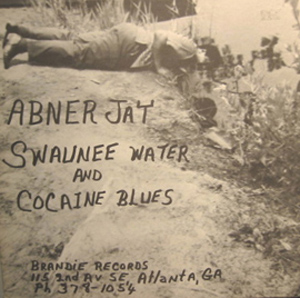
selection from the cover of Mississippi Records' recent Abner Jay release

Folk music is high class music--of course a lot of low class people singin' it. Matter of fact, most so-called folk singers don't even look like folk. Folk songs tell true stories, but terrible stories--'cause folk are terrible. Terrible songs make big songs. Why do you think kids like rock 'n' roll ? Because it's terrible. You think they're gonna listen to the Philadelphia Symphony, 101 Strings? Why do you think I like cocaine?

Tomorrow we will write more extensively about Abner Jay (1921-1996), a multifaceted musician and artist--and the self-proclaimed "last great Southern black minstrel show." His music (and his life story) was complicated and unconventional, but also singularly brilliant. 

Here Chris Campion of the Guardian writes of Mr. Jay:
Rather than cocaine, he used to claim that the secret of his eternal youth and vitality was lying on his belly drinking water scooped out of the Suwannee River in his home state of Georgia. And at least two of his albums (privately-pressed and released on his label Brandie, named after his wife) feature a photograph of him doing just that, along with the tracklisting, which he customarily scrawled over it in marker pen.

Jay was himself born near the source of one of the tributaries of the river in Irwin County, Georgia (in 1921). He started performing in medicine shows at the age of 5. In 1932 he moved on, to the Silas Green show, a travelling minstrel show and vaudeville revue that had also once employed Bessie Smith. Aged 14, he became a one-man band.
Enjoy these two selections from The True Story of Abner Jay, an earlier record re-released by Mississippi Records:


Monday, March 5, 2012

The Legend of Cas Walker

 The Cas Walker Knoxville city council fist-fight; LIFE Magazine

[Editor's Note: As I am facing numerous writing deadlines, this seems like a good time to give a retrospective glance to the first two years of Art of the Rural. Over these weeks I will feature a few new articles, but also many favorites from the archives. Thanks again to everyone who has read and contributed; what began as a labor of love has become a project far larger, and far more rewarding, than I ever could have anticipated - and I deeply appreciate the readership and participation of such a diverse audience. Starting March 12th, we will offer new articles and share some new projects related to our mission.

The Legend of Cas Walker was originally published on April 11, 2011.]
 
**********

I recently received an email and suggestion from Chuck Shuford, a writer and arts commentator for The Daily Yonder and a number of other publications. I think that many of our readers will be interested in this: the life and times and televised work of Cas Walker (1902-1998). Here's an excerpt from Mr. Shuford's correspondence:
My friend sent me a link to Cas Walker pontificating on his early morning TV program -- this was probably sometime in the 70's.   You need to know about Cas.  He owned a chain of grocery stores in E.TN, E. Ky, and SW Va.  He was also a politician, serving on the Knoxville City Council where he got in a fist fight at least once with a councilman holding a contrarian view.  He was elected Mayor of Knoxville and then very soon after, recalled.  He then ran for council again successfully until he retired in the early 70's. If god ever made an ornerier man, I've been hard to come by him.  As someone once said "If I ordered a car load of SOB's and they only sent Cas, I'd sign for it."  Dolly Parton and the Everly Brothers sang on his show as youngun's.   His home, which he lived in until his death, is about 3 blocks from our home.  Ironically, it is now owned by a lefty UT professor who recently wrote a book on Eugene V. Debs.
Writing in the Knoxville Metro Pulse, Betty Bean reveals how this "Hillbilly Collosus" also possessed an ability to manipulate media and technology:  
Cas had served on City Council longer than I’d been alive, and had been among the first to grasp the power of television not only for selling stuff but for fighting off fluoridation, metro government, bad check writers, shoplifters, dog thieves, civic improvements of any sort, and police officers who hung around and drank coffee in establishments other than his own.


YouTube offers a small selection of Cas Walker Farm and Home Hour clips, including one of the Dolly Parton performances Mr. Shuford alludes to above. Is that Waylon Jennings playing on the right of the screen?


Cas Walker's life is impossible to summarize in just a few paragraphs, so please refer to this lively and surprising feature by Ms. Bean in the Metro Pulse. Mr. Walker's ascension to millionaire grocery magnate is marked by a rough, self-conscious transition from rural to urban life--and a hatred (an accurate word in this case) for "the silk-stocking crowd" who taunted him during his youth. While he had a combative sense of class, and an equally combative political sense, even those who opposed him in these regards were charmed and even awe-struck by the stubborn creativity Mr. Walker channeled into The Farm and Home Hour and his grocery store promotions.

Ms. Bean writes extensively of one of Mr. Walker's most legendary exploits, when he buried local character Digger O'Dell alive for multiple weeks, just to generate increased sales at this grocery stores:
"He [Digger O'Dell] said 'I will be buried, six feet underground, with a stovepipe running down to where I am so people can talk to me.' I [Cas Walker] said, 'What do you get for that kind of work?'"
He said "I get $100 a day.'
"I said 'I was thinking about offering you $25 a day, but I am going to offer you $50.' His wife was a Jewish woman and she was shaking her head yes so I knew I was going to start burying a man and I had never had that experience before.
"We dug our hole, and I got ready to bury him. Of course, I advertised that I was going to bury him at a certain time. You never seen a crowd like we had."
Digger had a telephone, and Walker remembers that he "talked with women all night. You have never experienced a ladies man such as this one was."
Walker put up a tent over Odell's grave to accommodate the crowd, which one night numbered 1,500 at 2 a.m.
But Digger wanted to be dug up before he had fulfilled his 30-day contract. Walker was having none of it, since daily receipts at the Chapman Highway store had increased from $3,500 to $8,000.
"I told him that was too much money to dig up," Walker said in a 1990 interview with the Knoxville Journal.
Digger started faking heart attacks and calling the newspapers and the health department to complain that Walker was denying him medical care.
Walker's solution was to dress two women who worked for him in "nurse suits" and station them above the grave, selling barbecued chicken sandwiches.
Knoxviews offers a brief write-up of these stunts (including the LIFE Magazine fist-fight)--make sure to read the comments section, as many local folks contributed their own memories of Cas Walker.

The Tennessee Archive of Moving Image and Sound also houses many of the historical Cas Walker commercials and Farm and Home Hour tapes. TAMIS deserves its own post here on the The Art of the Rural, and that will be forthcoming, but, until then here is one of the archival commercials:


The Museum of Appalachia also features John Rice Irwin remembering Mr. Walker and his love for Coon Hunting.

Wednesday, February 29, 2012

Bessie Harvey And Her Tennessee Roots

Untitled (Cobra).  23 1/2 x 18 x 19" paint on wood with beads

[Editor's Note: As I am facing numerous writing deadlines over the second half of February, this seems like a good time to give a retrospective glance to the first two years of Art of the Rural. Over these weeks I will feature a few new articles, but also many favorites from the archives. Thanks again to everyone who has read and contributed; what began as a labor of love has become a project far larger, and far more rewarding, than I ever could have anticipated - and I deeply appreciate the readership and participation of such a diverse audience. In March we will offer new articles and series, and share some new projects related to our mission.

Bessie Harvey And Her Tennessee Roots was originally published on July 12, 2010.]

The American Folk Art Museum in New York City is currently featuring an exhibit entitled Approaching Abstraction, a survey of work from their permanent collection that counters the popular assumption that "contemporary self-taught artists work solely in a representational style, eager to engage in storytelling and personal memory." As the introductory materials to this show suggest, perhaps modern art audiences have been missing the ways in which these artists (from both rural and urban backgrounds) have been--while addressing the "social" content of their work--also thinking about the formal and aesthetic questions that we normally associate with the academic, insider, art world:
But while the narrative tradition often is a primary impulse, a significant number exhibit a tendency to be seduced by material, technique, color, form, line, and texture, creating artwork that omits or obscures representation.
The exhibition's insistence here is fresh, and in some ways vindicating. While Ken Johnson's review in The New York Times rightly suggests that we can't successfully separate the stories of these artists from the pure "form, line and texture" of their work, it also seems to reflect back on the industry and academy outside these pieces: how often, when viewing much modern and post-modern visual art do we find an absence and, indeed, a refusal of social content? It's refreshing then to watch AFAM curator Brooke Davis Anderson describe the exhibition below:


Ms. Davis spends a significant amount of time towards the end of this segment with the work of Bessie Harvey (1929-1994), an artist from eastern Tennessee who worked primarily with roots, though her art differs in profound and wonderful ways from the root club sculptures of Stan Neptune, who we discussed in March. The Bessie Harvey Homepage is the best place to begin discovering her work; it was written by The Knoxville Museum of Art in conjunction with local Austin-East High School, and it interweaves Ms. Harvey's biography within the developing arc of her sculpture. It's a story of uncanny perseverance in the face of cultural and familial obstacles, a triumph of the spirit and of a woman's faith in her religion and her own abilities as an artist. As the Approaching Abstraction exhibit would suggest, her own relationship with her artistic medium--though in a different time and place--bears an intimacy that we might associate with great masters of abstraction such as Mark Rothko. Here's an excerpt from the Homepage:
After resonding to its form, Harvey often sought its identity by speaking to it directly, asking, "Who are you?" For the sculpture Birthing, however, the artist's initial indentification proved to be incorrect: "I went out into the yard and I found this piece and to me it looked like an old man leaning on a walking stick." After bringing it into the house, Harvey was shocked that her vision had suddenly and dramatically changed to that of "an African girl; she's a queen, and she's giving birth to a baby, and the baby's head's already out." As with Birthing, Harvey often was struck by the fact that her imagery sometimes seemed disconnected from her life experience, as if extracted from a previous lifetime on another continent: "I get the feeling that I been in the world before, and I think it was in the darkness of Africa," and "There are some things that I know and some things that I do that I can't understand how I know these things if I haven't been here before."

Tuesday, February 21, 2012

Two For Mardi Gras

Zulu Parade 2010 King Jimmie L Felder; Eliot Kamenitz, Times Picayune

Here's two videos with a bit of Mardi Gras spirit. First, from the Alan Lomax Archive Channel, comes this footage shot by Alan Lomax and his crew in 1982: "Big Chief Jake Millon and the White Eagles Mardi Gras Indians rehearse 'Little Liza Jane' at Darrell's Lounge, 7th Ward, New Orleans."


Though geographically distant, David Lundahl's "Volcan Man" performances are located in a similar region of exuberance, also honoring the passing of a season. Yesterday we published a consideration of this boundary-crossing artist in Contemporary (Rural) Art: You Can't Make That Here.


Many thanks to Rachel Reynolds Luster for her assistance. Happy Mardi Gras!

Wednesday, February 8, 2012

Rural Poetry Series: C.D. Wright

I’m country but sophisticated. I’m particular and concrete, but I’m probing another plane. . . . There are many times when I want to hammer the head. Other times I want to sleep on the hammer.
     - C. D. Wright

C.D. Wright was born in Mountain Home, Arkansas, and her experience within the Ozarks and her native region have left an unshakable mark on a career that's seen the poet and her work meet with audiences across the country.

Wright is the daughter of a judge and a court reporter; this biographical note helps to provide a familial and regional context for poems which can stun and dizzy readers in their abilities to transcend normal temporal and spatial expectations. In books such as Like Something Flying Backwards: New and Selected Poems (2007) or the much-loved Deepstep Come Shining (1998), Wright utilizes a one-of-a-kind amalgam of narrative, collage, and lyrical techniques - yet, unlike a great many of her contemporaries, this stylistic DNA is not an end in itself, but a way of telling stories deeply rooted in local experience. 

Her most recent book, One With Others, was a finalist for the 2010 National Book Award in Poetry. Dan Chiasson, writing in The New Yorker, offers this excellent introduction to both the book and Wright's poetics:
In August, 1969, a Memphis man known as Sweet Willie Wine led a group of black men on a four-day March Against Fear, from West Memphis to Little Rock, passing through the small towns of the Arkansas delta. One with Others the Arkansas-born poet C. D. Wright’s new, book-length poem, tells the story of the march, and of the only outsider to join it, a small-town white woman, Margaret Kaelin McHugh, whom Wright calls V. The gnomic title suggests the bargain that V made: the act that momentarily unified her with others permanently singled her out. Becoming “one with others,” she ended up a pariah—one with others. The book is foremost an elegy for McHugh, whom Wright, in interviews, has described as “a giant of my imagination, an autodidact, deeply literary, an outraged citizen, a killingly funny, irresistible human.” 

The era has been so memorably captured in documentaries that, even when you imagine it, you end up drifting into documentary conventions. It turns out that the literary genre least likely to get in the way of this story is poetry, which, despite its reputation for gilt and taffeta, comfortably veers close to “documentary” conventions. It comes especially close in Wright’s angular strain of postmodern poetry, which draws on refractive techniques now a hundred years old: collage, extensive quotation, multiplicity of voice and tone, found material, and, often, a non-authorial, disinterested stance. “One with Others” represents Wright’s most audacious experiment yet in loading up lyric with evidentiary fact.
Here is video of Wright on PBS NewsHour reading a selection from One With Others from her home outside of Providence, Rhode Island; an excerpt from the long poem is also included below:


If white people can ride down the highways
with guns in their trucks
I can walk down the highway unarmed
Scott Bond, born a slave, became
a millionaire. Wouldn’t you like to run wild
run free. The Very Reverend Al Green
hailed from here. Sonny Liston a few miles west,
San Slough. Head hardened
on hickory sticks. A reporter asks a family
of sharecroppers quietly watching the procession,
Does this walk mean anything to you.
The father says, the others nod,
It means that Sweet Willie Wine is walking.

Saturday, February 4, 2012

Monday, January 16, 2012

Walking and Singing With Martin Luther King

Martin Luther King and Coretta Scott King joining The March Against Fear, 1966

The ultimate measure of a man is not where he stands in moments of comfort and convenience, but where he stands at times of challenge and controversy.
     - Martin Luther King, Strength to Love

In celebration of this year's Martin Luther King, Jr. Day of Service, a "national day on," we will offer some material throughout the day to help consider the legacy of MLK and his enduring message for all Americans.

Even beyond the powerful social change created through the efforts such as The March Against Fear, which crossed the length of rural Mississippi, there's a profound metaphor at work, as these brave Americans pushed at regional, rural, and urban boundaries - and linked communities across the country through a shared belief in human dignity.

And the annual commemorations on this day remind us that there's much more work to be done. Here's John Lewis and Harris Wofford, some of the congressional leaders responsible for officially transforming MLK Day from a holiday to a day of service. Please follow this link to find opportunities to volunteer:


• Smithsonian Folkways' Voices of the Civil Rights Movement: Black American Freedom Songs 1960-1966 contains many songs that may have been heard by Dr. King and his fellow marchers on that day in rural Mississippi when the photograph above was taken. Here's one selection from that recording: "Lord Hold My Hand While I Run This Race:"


• Here's a powerful link between John Coltrane (born in Hamlet, North Carolina), Dr. King, and the lives of four girls lost in the 16th Street Baptist Church bombing in 1963:

Saturday, January 7, 2012

Weekend Song: Napolian Strickland

Napolian Strickland on fife, R.L. Boyce on snare drum, Othar Turner dancing; Blues Unlimited

Yesterday the Alan Lomax Archive Channel offered an update with a distinctive video of Napolian Strickland singing and providing his own accompaniment on the diddley-bow:


As the notes inform us, "Jesus Stop By Here" is "a variant of "Jesus Won't You Come By Here" or "Daniel In the Lion's Den,'" and the footage was filmed by Alan Lomax, John Bishop and Worth Long in 1978. Mr. Strickland, like Fred McDowell and a host of other Mississippi blues luminaries, hailed from the town of Como. 

Folks can head over to the Association for Cultural Equity to learn more about Mr. Lomax's work in this region, and the excellent Folkstreams site offers The Land Where the Blues Began, the film from which this outtake emerges.

In addition to this, The Cascade Blues Association offers an introduction to Mr. Strickland's work, a portion of which is included below:
Of all the traditional styles of Blues music being played today, perhaps the fife and drum bands of Northern Mississippi just may have the deepest roots. The percussive sounds are almost a direct link back to the Western Coast of Africa, where slave traders took their heaviest toll; a land where stringed gourds, woodwind instruments and drums played a major role within the communities, and the memories continued with the poor souls being brought to a new land. The fife and drum bands thrived in the Hill Country of Mississippi for many years, with standout performers such as Sid Hemphill and his granddaughter, Jesse Mae, Ed Young and Othar Turner. But, as the practitioners of this music have been passing on, the tradition appears to be dying.
Another key member of the fife and drum family departed this world on July 21, 2001, as Napolian Strickland died following a stroke. Strickland was arguably the premier fife player of the genre, having appeared at numerous festivals, on several recorded compilations and on film in the documentary, "The Land Where The Blues Began".