Showing posts with label urban rural. Show all posts

Wednesday, March 14, 2012

David Lee, Carolina Soul & The Paradise of Bachelors Record Label

David Lee with the Washington Sound record shop sign, in front of his storage trailer;  

[Editor's Note: As I am facing numerous writing deadlines, this seems like a good time to give a retrospective glance to the first two years of Art of the Rural. Over these weeks I will feature a few new articles, but also many favorites from the archives. Thanks again to everyone who has read and contributed; what began as a labor of love has become a project far larger, and far more rewarding, than I ever could have anticipated - and I deeply appreciate the readership and participation of such a diverse audience. Starting March 19th, we will offer new articles and share some new projects related to our mission.

David Lee's Carolina Soul was originally published on August 2, 2011.]

********** 

Long-time readers might remember our piece from last year on the Carolina Soul site and the Paradise of Bachelors record label. POB's first release, Said I Had A Vision: Songs & Labels of David Lee 1960 - 1988 was one of our absolute favorite records from 2010--and the release has continued to get some wonderful press, so I'd like to start off the week by sharing some of this information. If we've hit the summer doldrums (August), this record is the best antidote I can imagine. Paradise of Bachelors is now offering a limited edition LP repressing; folks can find the digital download at iTunes or Amazon Music. 

Here's "You've Been Gone Too Long" by Ann Sexton. As the liner notes explain, "the tune must make any list of curious, 'Jody' genre songs, for its reference to the archetypal male opportunist who, according to Vietnam-era folklore, would latch onto women whose husbands or boyfriends were serving overseas." 


While we are currently in a golden age of reissues and unearthed music, with more and more coming out each week, what sets Said I Had a Vision apart is its combination of context (rural North Carolina, from the civil rights era to the Reagan era), the  quality of its songwriting, and the absolute exuberance of the performances. Many such records have these qualities in unequal parts, but Said I Had A Vision contains songs that exceed the normal obscurity-fetish that similar records often cultivate. After I play this record through, I generally feel like everyone I know needs to hear these songs.

It should be no surprise, then, that the music press has embraced this record and the regional vision behind the Paradise of Bachelors label, which is co-curated by folklorists Jason Perlmutter and Brendan Greaves. I was excited to learn that Wax Poetics had featured Said I Had a Vision in a recent issue; here's Jon Kirby:
A man of faith, [David] Lee's output tended towards the spiritual. And although most benefit from Cleveland County's proximity to Charlotte's Arthur Smith and Reflection Studios, perhaps his most generous offering was recorded on location at Mice Creek Baptist Church, in nearby Gaffney, South Carolina. "On My Way Up" by the Relations Gospel Singers showcases the careening lead of Steve Allen, whose exorcism range leaves church-van tracks through a field of delicate piano and choral support, recalling the fly-on-the-wall intimacy of an Allan Lomax artifact. Much of Lee's color-blind songwriting was realized by the Constellations, a salt-and-pepper ensemble who, during Shelby's annual Art of Sound Festival last October, proved they could still do "The Frog," walking sticks in hand. "They were just like kids to us when they started," revealed wife Nelena of Lee's most allegiant act. "We was just like a big family, rolled up together." With the exception of "northern soul" curiosity Ann Sexton, most on Lee's short-but-sweet roster still reside in Cleveland County, like blue-eyed crooner Bill Allen from nearby Cherryville. "You probably drove past there!" exclaims Lee. "You should have hollered for Bill when you was coming through." 
Further write-ups on the resurgence of interest in Mr. Lee's work has appeared in Our State magazine and The Charlotte Observer. Earlier this year, Mr. Lee was awarded the Brown-Hudson award by the North Carolina Folklore Society, introduced by Mr. Perlmutter and Mr. Greaves. Afterwards, he gave a performance of "I Can't Believe You're Gone" and "I'll Never Get Over Losing You," the latter of which appears on Said I Had a Vision: 


Paradise of Bachelors will release an LP/download of new material emerging from the South this fall: Poor Moon by the much-loved and critically-acclaimed Hiss Golden Messenger. Also in the works is a release of new and remastered material by Willie French Lowery, a member of the Lumbee Tribe in North Carolina and who has worked previously with the psychedelic bands Plant & See and Lumbee. I'll include a sample of each artist below; you can also follow the latest Paradise of Bachelors news on their Facebook page.


Hiss Golden Messenger from Gianmarco Del Re on Vimeo.


**********

[Discovering Carolina Soul was originally published on September 23, 2010]

The former Washington Sound on Buffalo Street in Shelby, NC; from Carolina Soul

Throughout the sixties and seventies, at least one hundred African-American-owned R&B/Soul record stores thrived in the Carolinas. These retail shops, with their close links to recording studios and local record labels, were on the front lines not only of new musical ideas, but of the civil rights struggle itself. Today, this music's story is being told in a compelling fashion on the Carolina Soul blog/archive, which has spent the last five years locating and documenting the wide array of R&B/Soul music created in North and South Carolina--much of which has never been re-issued since its original release as 45 rpm records.

If you peruse Carolina Soul's extensive discography the material object of the vinyl record begins to stand as a symbol for a kind of rural-urban linkages that revolutionized the last half-century's artforms and its push toward social justice.  This effort to rediscover these recordings, and to tell the stories of these musicians and their communities, is led by Jason Perlmutter (a chemist and local music collector) and Jon Kirby (an associate editor at Wax Poetics). Mr. Perlmutter, in partnership with folklorist Brendan Greaves, has begun the Paradise of Bachelors record label and is currently pressing their first release -- a retrospective of the music released on David Lee's various record labels entitled Said I Had A Vision.

Mr. Lee, who currently resides in Mooresboro, ran the Impel, Washington Sound and SCOP (Soul, Country, Opera, Pop) labels and often contributed his own songs to his musicians. Carolina Soul recently visited Mr. Lee, and, earlier in the year, the folks behind this project spent time talking with some of the artists who worked with him. Here we see the The Constellations, both then and now:


Here, from the Paradise of Bachelors' blog, is a description of the ground-breaking work done by The Constellations:
We spent an illuminating and pleasant afternoon in Mooresboro, North Carolina with the Lees; Harold Allen, Don Camp, William “Butch” Mitchell, and Benjamin and Bryan “Brownie” Guest of the Constellations. Hearing these gentlemen’s stories about unflagging brotherhood, camaraderie, and the timelessness of “love ballads”–in the face of physical threats, racist invective, and a Southern and national climate opposed to their very existence–was truly inspiring. The Constellations were the first mixed-race combo in the area, and they did it as mere kids, getting started in 1958 or 1959 as teenagers and only dissolving upon the departure of members to Vietnam in 1964 and 1965.

In that time, they recorded six energetic sides for David Lee, all of which belie their tender ages, plus two unreleased tracks–”Have You Seen My Baby?” and “I Want to Jerk”–which Mr. Lee sent to Benjamin Guest while he was serving in Vietnam. Those tapes may yet emerge for your delectation…
We can only hope to that some of this music makes its way on to Carolina Soul or onto a newly-pressed piece of vinyl via Paradise of Bachelors.

As a closing note, for those who would like to hear these gentlemen put these songs into a more eloquent context than I can provide, please refer to their interview with Frank Stasio on NPR's The State of Things.

Tuesday, March 13, 2012

What We Talk About When We Talk About The Rural

Cast-iron stove reclaimed by David Lundahl from a local farm;  the foundation for a new sculpture

[Editor's Note: As I am facing numerous writing deadlines, this seems like a good time to give a retrospective glance to the first two years of Art of the Rural. Over these weeks I will feature a few new articles, but also many favorites from the archives. Thanks again to everyone who has read and contributed; what began as a labor of love has become a project far larger, and far more rewarding, than I ever could have anticipated - and I deeply appreciate the readership and participation of such a diverse audience. Starting March 19th, we will offer new articles and share some new projects related to our mission.

What We Talk About When We Talk About The Rural was originally published on August 15, 2011.]

**********

While working on an Art of the Rural project at New Light Studios in southern Wisconsin, the self-created arts environment of David Lundahl (who, despite physical and economic hardship, rebuilt a dilapidated dairy farm into a vibrant arts space) I had a moment to learn that some of my comments after the recent Talk of the Nation piece on rural America were printed in The Daily Yonder, and that TOTN's Blog of the Nation gave The Art of the Rural an enthusiastic mention. It's an honor on both fronts, and timely, as I spent a good part of the drive up to New Light Studios thinking about the TOTN piece and its reception. 

If folks haven't had a chance yet, I'd encourage a listen--and also a perusal of the TOTN comments section both there and on the Blog of the Nation follow-up.  Very quickly, the real concerns over the loss of rural posts offices were either swept off the table by some commenters ("These towns have no other buildings they can't meet in front of?") or subsumed into predictably digested political rhetoric ("If you want rural America to have stuff like P.Os., health clinics, and communications access, you'd better vote for a "big-government" Democrat."). 

Of course, this is the level of discourse on a number of internet forums and comments pages--a gruesome spectator sport all to itself. What's different here is that, in my opinion, the Talk of the Nation piece was not entirely successful in its communication of the diverse set of complexities enmeshed in contemporary rural life--and it almost entirely ignored the question of rural arts and culture, the very fabric that unites these communities. 

While NPR consistently provides some of best broadcast news and commentary to be found anywhere, and while (contrary to aforementioned political rhetoric) both my conservative and liberal friends seem to value its in-depth coverage (see the reports from the GOP straw poll in Iowa), I left the rural segment of Talk of the Nation discouraged on a basic level. Here's a portion of my reaction published in The Daily Yonder:
More than anything, I wish the NPR producers had the foresight to keep Dee Davis [President of the Center for Rural Strategies] on the line with Neal Conan for the whole segment, so that he could have helped contextualize the excellent perspectives of the guests.

This is telling: culturally speaking, as Americans, do we all assume we "know" the rural equally well? Do we admit that the "face" of rural America is changing, that there are many people in cities who identify as "rural," and that rural youth have a stake in these discussions?

Neal's language during the transitions spoke (alternately) to all the old assumptions about rural America: it's either a pastoral or a broke-down ghetto. The guests offered perspectives that challenged this, but I worry that the format of the segment and Neal's questions may, in the end, not have done the work of challenging his listeners--something NPR is generally adept at doing.
Writer and producer Mary Phillips-Sandy has added a much-needed critique of that use of language on her excellent A Lot of Consonants blog:
One of the things that stood out to me was the host’s use of the word ‘heartland’ as a synonym for ‘rural America.’ It’s a common idiom and a disingenuous one. Where is this heartland, exactly? Does the expression mean a geographic center or an emotional center? If the former, it fails to include all the parts of rural America that exist at the nation’s edges and farthest-flung points. If the latter it is patronizing, because it locates rural America in the realm of abstract sentiment, instead of on a map, right there, or right here.
An emotional center, in the realm of abstract sentiment: this eloquently gets at how Americans with little direct rural-experience can sometimes describe and qualify non-metropolitan life. If we think about this from a literary perspective, the use of "heartland" is simply an updated term for "Arcadia," that place of the literary pastoral invented by Theocritus--writing from the library in Alexandria, ca. 300 B.C. For this poet, it was a place of shaded groves of song and love, a landscape of man's communal experience with nature. 

In actuality, Arcadia was a rocky and barren region where very little grew. Two millennia later, we find that readers (and nations) need to have a pastoral myth, a place to invest the unalienable values of their people. And, updated in the modern age, they also need to view their Arcadia simultaneously as back-woods region where acts and sensibilities that would not be tolerated in urban centers can somehow be found permissible (consolidated schools, drastically insufficient health services, mountaintop removal, and so on).

Whether the author is Theocritus or a speech-writer for any of the forthcoming 2012 campaigns, this language ignores one basic and inseparable fact: the rural and the urban are intimately connected.

Friday, March 9, 2012

Abner Jay: The Last Southern Black Minstrel Show

Abner Jay, April 8, 1982, San Jose Flea Market; selection of a photo by Jon Sievert

[Editor's Note: As I am facing numerous writing deadlines, this seems like a good time to give a retrospective glance to the first two years of Art of the Rural. Over these weeks I will feature a few new articles, but also many favorites from the archives. Thanks again to everyone who has read and contributed; what began as a labor of love has become a project far larger, and far more rewarding, than I ever could have anticipated - and I deeply appreciate the readership and participation of such a diverse audience. Starting March 19th, we will offer new articles and share some new projects related to our mission.

Abner Jay: The Last Southern Black Minstrel Show was originally published on March 3, 2011.]
 
**********
 
In this post, and the previous post below, we're considering the life and music of Abner Jay--a figure whose art cuts across so many themes central to the American experience: race, class, regionalism, history, and place. Mississippi Records has just released Mr. Jay's final recordings, entitled Last Ole Minstrel Man.

I've heard from a number of folks in the two days since the previous post, readers who have been bowled over the emotion, creativity and cultural import of Mr. Jay's work. Today I'd like to share more information and links. Beyond that, the best thing to do is to sit down with his records, turn off the phone, and just listen.

Abner Jay was born in Fitzgerald, Georgia in 1921, into a family of sharecroppers. Though various internet sites tell the story slightly differently, Mr. Jay's grandfather--and perhaps his father--had been slaves. The legal terminology, however, is of less import than the realities of those early years of his life. Amoeba Records' blog offers a generous transcription (from the current release's liner notes) of Mr. Jay's own recollection of this time period:
"Abner was a slave sixty five years after the slaves were freed, because Abner grandpa and Pa love the slave life. Abner was hired out to white plantation owners when he was at the age of six. Abner worked as a slave side by side with his grandpa, a former slave. Abner could not and did not receive his pay until after he was twenty one years of age. Abner ate and slept in the barn with the mules. The White folk would hand his food out of the back door to him in a pan, mostly left overs and the food the white folk dogs wouldn't eat...

"Abner start singing on the public for the white plantation owner when he was eight. Abner start playing banjo at the age of ten, and became a one man band and bone player at the age of fourteen. Abner would play in the rich homes for the plantation owners when they wanted to entertain."
Mr. Jay later toured with minstrel and vaudeville shows, eventually striking out as a young man on his own--a one man band. Along the way he became friends with Muddy Waters, Chuck Berry, James Brown and, according to some sources, Elvis. He was also the agent and manager to the phenomenal gospel singer Sister Rosetta Tharpe. In the final decades of his life, Mr. Jay traveled from town to town in a mobile home that could convert into a performance stage

Again, Chris Campion so clearly articulates the many attributes of the sound that might surprise attendees of a local fair or flea market:
Jay finger-picked a bittersweet but heartfelt comic blues on a long-necked, six-string banjo that he said had been made in 1748. It had been passed down to him by his grandfather, Louis W Jay, born a slave and later to teach Abner many of the traditions he made it his mission to keep alive.

He was almost certainly the last living exponent of the 'bones' - a musical tradition that involved playing percussive rhythms using various cow and chicken bones that had been dried out and blanched in the sun. Jay claimed to have a repertoire of over 600 songs, which he sung in a bone-shaking basso profundo voice, the legacy of a battle with throat cancer that almost felled him in his twenties.
He would perform field songs, minstrel tunes and Pentecostal hymns interspersed with his own nuggets of homespun philosophy, off-colour yarns and side-splitting one-liners. 'What did Adam and Eve do in the Garden?' runs one. 'Eve wore a fig leaf... and Adam wore a damn hole in it.'

Jay's own compositions were decidedly secular in nature and found him musing on atypical themes such as depression, the Vietnam war and substance abuse. Titles include 'The Reason Why Young People Use Drugs' and 'The Backbone of America is a Mule and Cotton'. 'I crave cocaine,' he moaned during crowd favourite 'Cocaine Blues', exaggerating his diction for comic effect. 'But I can't find nothing here in Atlanta. Cos those hippies dun used it all up... I want sum'tin to pep me up!'
For more information,  The Down Home Radio Show features Eli Smith's interview with Eric Isaacson of Mississippi Records; the two discuss the label's release of The True Story of Abner Jay as well as the true story of the record label itself, which has become a faithful steward of many later Abner Jay re-issues.

Here's a rare gem: an excerpt from Mr. Jay's final performance at the 1993 Grassroots Festival in Trumansburg, New York. We see in this personal rendition of "St. James Infirmary Blues" what Mr. Isaacson means when he says that people called Abner Jay "the black Bob Dylan." Even more forcefully than Dylan, Abner Jay stood with one foot in a lost, folkloric America and the other in the ground of rock 'n' roll, radio, and television. The great achievement of his music is that these contradictions are fused together in ways that can be  both deeply-moving and profoundly unique.  

We learn that he passed away days later, on his way back home.


**********

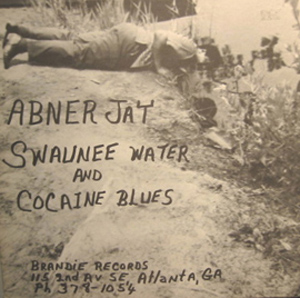
selection from the cover of Mississippi Records' recent Abner Jay release

Folk music is high class music--of course a lot of low class people singin' it. Matter of fact, most so-called folk singers don't even look like folk. Folk songs tell true stories, but terrible stories--'cause folk are terrible. Terrible songs make big songs. Why do you think kids like rock 'n' roll ? Because it's terrible. You think they're gonna listen to the Philadelphia Symphony, 101 Strings? Why do you think I like cocaine?

Tomorrow we will write more extensively about Abner Jay (1921-1996), a multifaceted musician and artist--and the self-proclaimed "last great Southern black minstrel show." His music (and his life story) was complicated and unconventional, but also singularly brilliant. 

Here Chris Campion of the Guardian writes of Mr. Jay:
Rather than cocaine, he used to claim that the secret of his eternal youth and vitality was lying on his belly drinking water scooped out of the Suwannee River in his home state of Georgia. And at least two of his albums (privately-pressed and released on his label Brandie, named after his wife) feature a photograph of him doing just that, along with the tracklisting, which he customarily scrawled over it in marker pen.

Jay was himself born near the source of one of the tributaries of the river in Irwin County, Georgia (in 1921). He started performing in medicine shows at the age of 5. In 1932 he moved on, to the Silas Green show, a travelling minstrel show and vaudeville revue that had also once employed Bessie Smith. Aged 14, he became a one-man band.
Enjoy these two selections from The True Story of Abner Jay, an earlier record re-released by Mississippi Records:


Friday, March 2, 2012

Bob Dylan's Direction Home

[Editor's Note: As I am facing numerous writing deadlines over the second half of February, this seems like a good time to give a retrospective glance to the first two years of Art of the Rural. Over these weeks I will feature a few new articles, but also many favorites from the archives. Thanks again to everyone who has read and contributed; what began as a labor of love has become a project far larger, and far more rewarding, than I ever could have anticipated - and I deeply appreciate the readership and participation of such a diverse audience. In March we will offer new articles and series, and share some new projects related to our mission.

Bob Dylan's Direction Home was originally published on January 25, 2011. His summer tour did not travel through Minnesota.]

**********
City’s just a jungle, more games to play
Trapped in the heart of it, trying to get away.
I was raised in the country, I been working in the town
I been in trouble ever since I set my suitcase down.
     --from "Mississippi"

Last week Aaron, a reader from Ohio, passed along some very interesting news. It appears that Duluth, Minnesota, Bob Dylan's birthplace, is actively working to bring back their estranged native son for a concert on his 70th birthday. The news of these plans has been documented in forums on the encyclopedic Dylan resource Expecting Rain, and was confirmed last month in the Duluth News Tribune, where John Ziegler reported that city officials are currently in talks with Dylan and his management to bring him back to Minnesota on or around his May 24th birthday. 

As with all things Bob Dylan, this story contains a good deal of rumor and apocrypha. For instance, I heard that the small mining town of Hibbing, Minnesota, Dylan's hometown, had originally sought to welcome the musician back on his 70th birthday (Aaron tells me that Dylan last visited for his ten-year high school reunion, where he was roundly ignored by his former classmates), yet Mr. Ziegler reports that Duluth had extended their invitation a full year ahead of schedule, contacting him on his 69th birthday. Regardless, if Dylan accepts this invitation we will see a great deal of media attention focused on his rural Minnesota roots. While there may be a nostalgic whiff to such reflections, it is significant to think of Dylan-the-70-year-old back in Minnesota, over four decades after he recorded his generation-defining howl of "no direction home".

If we put that song--and the long-view of Dylan's legacy--in perspective, then what could also come out of such a birthday in Minnesota could be a reappraisal of a whole generation's relationship to rural place. While Dylan did his best to shirk his "voice of a generation" status, it's clear that his life narrative, captured so eloquently in "Mississippi," is representative of many of his fellow baby boomers: that first wave of the "rural-brain drain," many of whom would later take part in the flight out of America's urban centers and into a suburban life where rolling stones meet their cul-de-sac. 

However, Dylan's last handful of records have embraced the traditional forms of blues and country music just as baby boomers are returning to facets of their own rural upbringing. While the local and organic food phenomenon is part and parcel of this generational trend, many are realizing (as Wendell Berry did so many years ago, in his essay "A Native Hill")  that you can go home again. In my own home region this has been occurring for a few years, as baby-boomers begin to form organizations to preserve our small Ohio Valley town--and to hopefully bring it back to some semblance of its former self. 

Beyond this, the issue becomes one of what "homecoming" means, and how the rural diaspora negotiates this return. As this teenager's video from Hibbing suggests, life never stopped in these communities, and those who stayed both welcome and resent the influence of those who left.

We'll be following the events surrounding this birthday concert; until then, here's a short video produced by the University of Minnesota in conjunction with the UM Press's release of Highway 61 Revisited: Bob Dylan's Road from Minnesota to the World, edited by Colleen J. Sheehy and Thomas Swiss:

Wednesday, February 29, 2012

Bessie Harvey And Her Tennessee Roots

Untitled (Cobra).  23 1/2 x 18 x 19" paint on wood with beads

[Editor's Note: As I am facing numerous writing deadlines over the second half of February, this seems like a good time to give a retrospective glance to the first two years of Art of the Rural. Over these weeks I will feature a few new articles, but also many favorites from the archives. Thanks again to everyone who has read and contributed; what began as a labor of love has become a project far larger, and far more rewarding, than I ever could have anticipated - and I deeply appreciate the readership and participation of such a diverse audience. In March we will offer new articles and series, and share some new projects related to our mission.

Bessie Harvey And Her Tennessee Roots was originally published on July 12, 2010.]

The American Folk Art Museum in New York City is currently featuring an exhibit entitled Approaching Abstraction, a survey of work from their permanent collection that counters the popular assumption that "contemporary self-taught artists work solely in a representational style, eager to engage in storytelling and personal memory." As the introductory materials to this show suggest, perhaps modern art audiences have been missing the ways in which these artists (from both rural and urban backgrounds) have been--while addressing the "social" content of their work--also thinking about the formal and aesthetic questions that we normally associate with the academic, insider, art world:
But while the narrative tradition often is a primary impulse, a significant number exhibit a tendency to be seduced by material, technique, color, form, line, and texture, creating artwork that omits or obscures representation.
The exhibition's insistence here is fresh, and in some ways vindicating. While Ken Johnson's review in The New York Times rightly suggests that we can't successfully separate the stories of these artists from the pure "form, line and texture" of their work, it also seems to reflect back on the industry and academy outside these pieces: how often, when viewing much modern and post-modern visual art do we find an absence and, indeed, a refusal of social content? It's refreshing then to watch AFAM curator Brooke Davis Anderson describe the exhibition below:


Ms. Davis spends a significant amount of time towards the end of this segment with the work of Bessie Harvey (1929-1994), an artist from eastern Tennessee who worked primarily with roots, though her art differs in profound and wonderful ways from the root club sculptures of Stan Neptune, who we discussed in March. The Bessie Harvey Homepage is the best place to begin discovering her work; it was written by The Knoxville Museum of Art in conjunction with local Austin-East High School, and it interweaves Ms. Harvey's biography within the developing arc of her sculpture. It's a story of uncanny perseverance in the face of cultural and familial obstacles, a triumph of the spirit and of a woman's faith in her religion and her own abilities as an artist. As the Approaching Abstraction exhibit would suggest, her own relationship with her artistic medium--though in a different time and place--bears an intimacy that we might associate with great masters of abstraction such as Mark Rothko. Here's an excerpt from the Homepage:
After resonding to its form, Harvey often sought its identity by speaking to it directly, asking, "Who are you?" For the sculpture Birthing, however, the artist's initial indentification proved to be incorrect: "I went out into the yard and I found this piece and to me it looked like an old man leaning on a walking stick." After bringing it into the house, Harvey was shocked that her vision had suddenly and dramatically changed to that of "an African girl; she's a queen, and she's giving birth to a baby, and the baby's head's already out." As with Birthing, Harvey often was struck by the fact that her imagery sometimes seemed disconnected from her life experience, as if extracted from a previous lifetime on another continent: "I get the feeling that I been in the world before, and I think it was in the darkness of Africa," and "There are some things that I know and some things that I do that I can't understand how I know these things if I haven't been here before."

Monday, February 27, 2012

Bringing The Yarn Bomb To The Country


[Editor's Note: As I am facing numerous writing deadlines over the second half of February, this seems like a good time to give a retrospective glance to the first two years of Art of the Rural. Over these weeks I will feature a few new articles, but also many favorites from the archives. Thanks again to everyone who has read and contributed; what began as a labor of love has become a project far larger, and far more rewarding, than I ever could have anticipated - and I deeply appreciate the readership and participation of such a diverse audience. In March we will offer new articles and series, and share some new projects related to our mission.

Bringing The Yarn Bomb To The Country was originally published on June 9, 2011. International Yarn Bombing Day is set for June 9th this year.]

By Rachel Reynolds Luster, Contributing Editor

International Yarn Bombing Day will occur for the first time this Saturday, June 11th. The event was the brainchild of Joann Matvichuk, a “domestic goddess” who lives and works in Lethbridge, Alberta. Her motivation is to encourage knitters and crocheters to perform crafted graffiti on the same day, around the world as a collective group.

For those not familiar with the concept of yarn bombing, it’s a form of graffiti and cultural activism that involves repurposing aspects of the urban landscape by covering them with knitted and crocheted adornments. The movement was started in 2005 by Texas artist Magda Sayeg. At the time, Sayeg was the owner of a yarn shop in Houston and was overcome with “a selfish desire to add color to my world.” In reaction to the urban landscape and the lack of warmth she found there, she knitted a cozy to cover the metal door handle of her shop. She then knitted a sheath for the stop sign across the street. Passersby stopped and noticed. They took pictures. She was encouraged by the reaction and began covering items across the city. 

Sayeg and a group of fellow knitters have since yarn bombed items across the world including parking meters in Brooklyn, a bus in Mexico, and a twenty-six foot statue of a soldier in Bali, neutering its violence, according to a 2010 article in The Guardian. In that same article, Sayeg says, “In this world of technology, over-development, fewer trees and more concrete, it is empowering to be able to beautify your environment." This is a powerful statement in action. Sayeg, now in Austin, has spawned an international movement with yarn bombing groups popping up not only across America but also in Japan, Britain, Scandinavia, South Africa, and Australia.

Generally done in cover of darkness, some of the participants wear masks and relish the role of artistic vagrants. Like all unsanctioned street art, yarn bombing is illegal, and Sayeg’s original group of knitters in Houston crafted a terminology for their work based on the world of hip-hop, creating names for themselves such as Notorious N.I.T. and P-Knitty. The group as a whole was called Knitta Please or just Knitta. Further information on the history of the movement, Magda, and International Yarn Bombing can be found here.  

I’m not really good at knitting, but I love to do it. I’ve crocheted for as long as I remember. My great-grandmother taught me when I was 4 or 5 to do a chain and basic single stitch. I remember getting a crocheted potholder every Christmas from Nanny with a five dollar bill folded up inside. While they were truly horrible potholders (acrylic yarn easily melts), I still have an entire collection along with the many scarves and pillows she made for me over the years. I keep them because they are touchstones of my time with her and all that she shared with me. They represent personal remembrances, a set of skills, and bright objects that are both functional and decorative.

I am also enamored with the idea of knitting or crocheting to affect cultural change. Yarn bombing definitely falls into the category of “craftivism,” a concept developed by Betsy Greer, whose website is a resource for many in the DIY and feminist craft movements. I love that those participating in yarn bombing, at least on one level, are taking action to reclaim their urban landscape, one that they see as cold and distant, by beautifying and changing it with a craft seen mostly as domestic, predominately functional, and in many circles--I would imagine especially in an urban context--irrelevant to modern society. Participants are reclaiming public spaces as home. Still, I have been contemplating what form such a movement would take in rural America and what the motivations and implications might be.

 Photograph by DPA

First, I believe that many of the rural yarn bombing projects would stay around. Rather than temporary remnants of acts of activism, removed promptly by city employees tasked with keeping the city clean, I think rural examples would be adopted by many as decorative aspects of community life and remain part of objects such as mailboxes or garden swings where they were placed. I also believe that it might cause a resurgence in rural textile craft and appreciation of it. If we factor in, for example in my community, that there are many people, especially women, raising fiber animals and creating yarn that could be used, the implications become economic. These are just some of the possibilities that come to mind, but I would like to encourage any of you who knit or crochet to yarn bomb something, anything, in your rural communities on June 11. Of course, I believe we should locally adapt our methodology for such activities. If you’re going to yarn bomb something at someone’s home, you might ask first. I think, probably, public spaces are fair game. It doesn’t have to be large, could be something as simple as the first door handle that Magda did at her shop in Houston. Yarn bomb your local senior center, or better yet, get those folks involved!

In the spirit of engagement, I sent a note to Joann Matvichuk, organizer of International Yarn Bombing Day, asking if she had communicated with any groups or individuals planning on participating in the event from rural America. She was kind enough to pose the question on the IYBD facebook page and received dozens of responses of interest. Two responses in particular struck me as relevant as we think about what the implications might be for rural yarn bombing activities.
Corrine MacKrell: “I grew up rural. If I were going to yarn bomb at home, I would personalize it like a gift. A camo scarf on or around the garden gnome of a hunting family, flowers in her favorite color for the lady down the road, etc.”
Shane Raymond: In the country we have to be more discrete and organic with our tags. Since I know most of the people and their personalities I can tailor my tags better as well. Overall I would say it's much more personal. Example, a colorful spider webs in the trees in deep state land. The only people that will see them are middle-aged hunters.
I encourage you to join the conversation on the International Yarn Bombing Day’s Facebook page. If you do a project, I’d love for you to share it with us. I’m interested in your photographs and in learning how the projects are perceived in your community. I’ll share my story too.

Friday, February 24, 2012

How The Rural Could Save Contemporary Art

Last Chance installation; Erik Van Lieshout, Art Basel

[Editor's Note: As I am facing numerous writing deadlines over the second half of February, this seems like a good time to give a retrospective glance to the first two years of Art of the Rural. Over these weeks I will feature a few new articles, but also many favorites from the archives. Thanks again to everyone who has read and contributed; what began as a labor of love has become a project far larger, and far more rewarding, than I ever could have anticipated - and I deeply appreciate the readership and participation of such a diverse audience. In March we will offer new articles and series, and share some new projects related to our mission.

How the Rural Could Save Contemporary Art was originally published on July 6, 2011. For more information, we recommend a visit to the Rural America Contemporary Artists organization.]

Last week, on the morning before The National Rural Assembly, I had the privilege of attending a roundtable discussion on rural arts and culture hosted at the Bush Foundation in Saint Paul. This conversation was cosponsored by the Arts and Community Change Initiative, the Arts and Democracy Project, the Center For Rural Strategies, and InCommons -- and these organizations brought together an inspiring cohort of artists, scholars and arts practitioners working to cultivate the cultural life of their rural communities.

A profound number of challenges and solutions were raised in those discussions; while I will offer a more detailed summary of the events soon, a few persistent questions emerged and then re-emerged across the morning's conversation: How do we create and share art that speaks from our local cultures, yet also reflects the modern economic and global realities of our places? What is the tension between  traditional and modern (university-endorsed) notions of art-making? Is there a way to integrate these practices into the stories a community tells about its past, present, and its future? How does the community's access to technology (especially broadband) alter this work? And, importantly, how do we impart all of these concerns to the next generation--how do we offer a narrative of plabe and culture inclusive to rural youth?

Though these are large questions, and their solutions will be years in the making, I was ultimately struck by how different these discussions sounded than those that revolve around the contemporary art world, or even its adjacent academic community. While there are daunting imperatives in the preceding paragraph, its content is surely not rural-specific. However, because of the host of pressing issues facing rural America, many of our artists and arts organizations must directly engage with these questions of representation and equity, and with art's tenuous position in communities dealing with crises in health care, housing and education. Because our work takes place on a smaller scale, we turn from these issues at our own peril. As a preface to the roundtable discussion, Dee Davis, president of The Center of Rural Strategies, offered this timely line from W.B. Yeats: in dreams begin responsibilities. 

So, how could the rural save contemporary art? 

I'd like to offer below three recent editorials by respected art critics, writing for respected arts publications. Each writer, upon returning from the major summer art shows (here, the Venice Biennale and Art Basel), identifies specific symptoms of a general sickness in the art world. On one hand, it's heartening to hear these writers articulating some of very same concerns of folks engaged in rural arts and culture; on the other hand, the sickness diagnosed here seems to beg not only for greater equity and inclusion along economic and geographical lines, but also for a wider sense of cultural inclusion. I'd like to offer these three articles, and then suggest that folks consider the rural artists they know (or those we've highlighted here on in our links and map resources): from the traditional to the avant-garde, how would a broader discussion of these artists help to make the contemporary-art-body whole and healthy?

Writing in New York Magazine, Jerry Saltz laments "Generation Blank," the coterie of recent university-trained artists who are "too much in thrall to their elders, excessively satisfied with an insider’s game of art, [and] not really making their own work." Here is how Mr. Saltz begins his editorial:
I went to Venice, and I came back worried. Every two years, the central attraction of the Biennale is a kind of State of the Art World show. This year’s, called “Illuminations,” has its share of high points and ­artistic intensity. (Frances Stark’s animated video of her online masturbatory tryst with a younger man hooked me; Christian Marclay’s The Clock, which captivated New York earlier this year, rightly won the Gold Lion Prize for Best ­Artist.) Yet many times over—too many times for comfort—I saw the same thing, a highly recognizable generic ­institutional style whose manifestations are by now extremely familiar. Neo-Structuralist film with overlapping geometric colors, photographs about photographs, projectors screening loops of grainy black-and-white archival footage, abstraction that’s supposed to be referencing other abstraction—it was all there, all straight out of the seventies, all dead in the ­water. It’s work stuck in a cul-de-sac of aesthetic regress, where everyone is deconstructing the same elements. 

Sixth Still Life installtion; Katharina Fritsch, Venice Biennale

In our second arts clipping, András Szántó of Artworld Salon returns from Art Basel and offers two examples of "interesting disconnects" in recent art news:
First, between the ebullience of the art fair and the dark financial clouds roiling over Europe, where states teeter on the edge of insolvency and people are taking to the streets. There is a yawning chasm right now between the revived luxury spending boom and the malaise that grips the bottom ninety-eight percent. The subject kept coming up, quietly but persistently, at parties around town. 
Second, during an Art Basel Conversation I moderated on the future of museum collecting, a London-based curator from Bangladesh pressed the assembled directors, and in particular Chris Dercon of the Tate Modern, when and how they will genuinely engage his community and others like it—not just through occasionally showcasing artists, but in a deep way. All agreed that, good intentions and planned initiatives notwithstanding, we’re a long way from making art institutions truly inclusive.

Away From The Flock; Damien Hirst

In "We Don't Own Modern Art - The Super Rich Do," Jonathan Jones of The Guardian recasts Szántó's question with an eye on the mainstream middle-class audience that still grants contemporary art its cultural legitimacy:
But who are they, these people? I would genuinely like to know. The popular assumption seems to be that today's art collectors are "Russian oligarchs". Certainly the spectacle of Roman Abramovich's yacht drew attention to the oligarchic presence at this year's Venice Biennale. One thing is certain – the big-time buyers of art are people in the financial sector who are weathering our troubled times a lot better than high street businesses, nations picked on by Standard & Poor's, or public sector workers.
And yet, for the last couple of decades, contemporary art has flourished through an alliance of the rich and the not-so-rich. It is the same educated, probably public-sector-employed middle class (many of whom marched this week) that enthusiastically visit galleries and art fairs. It is these fans of modern art who have helped, by their acclaim, to generate the charisma that makes it apparently worth so many millions.
Of course, we're already seeing an urban, university-educated, DIY arts movement that is helping to provide the response to these writers' concerns; this DIY culture, which is beginning to make inroads to rural artists and organizations, carries an aesthetic and a sense of empowerment that we all should observe and then integrate into our work. Further, as advocates for rural arts and culture, we should consider what we can bring to broader discussions like those above--and not cultivate an anti-modern art, anti-intellectual stance that only denigrates urban and rural audiences alike.

After reading these pieces, and after an inspiring roundtable discussion, I take away two beliefs. First, by including to a greater extent the voices of rural arts and rural groups within our contemporary arts dialogue, we will make all of the Arts more healthy--and more relevant to more people. And, lastly, the rural can save contemporary art in much the same way that contemporary art can come to the service of the rural: by working across those rural-urban lines and recognizing our shared responsibility to each other.

Monday, February 20, 2012

Contemporary (Rural) Art: You Can't Make That Here

photograph by David Lundahl

[Editor's Note: As I am facing numerous writing deadlines over the second half of February, this seems like a good time to give a retrospective glance to the first two years of Art of the Rural. Over these weeks I will feature a few new articles, but also many favorites from the archives. Thanks again to everyone who has read and contributed; what began as a labor of love has become a project far larger, and far more rewarding, than I ever could have anticipated - and I deeply appreciate the readership and participation of such a diverse audience. In March we will offer new articles and series, and share some new projects related to our mission.

[Contemporary (Rural) Art: You Can't Make That Here was originally published on August 3, 2010. Please see the links below the article for further coverage of Lundahl's work here and here ; we recommend a visit as well to the Rural America Contemporary Artists organization.]

*****
I recently had an opportunity to re-visit David Lundahl, the photographer, sculptor and musician from southern Wisconsin who (over 15 years) has taken 115,000 Polaroid self-portraits. When we originally discussed his work a few months ago, I spoke of the process itself: how the layers of stencils, gelled prints, and natural media (scarves, bark, shark jaws, among others) combine with a complex series of mirrors to harness natural light to create a startling level of three-dimensionality to his photographs. I also spoke of his life itself in some detail, which I'll reprint below:
The story of David Lundahl's art and life can't really be put into one paragraph, but, as an introduction, here it goes. Mr. Lundahl's art, and his choice to live in rural Wisconsin, all speak to his lived experiences. He contracted polio as a boy in the 1950's and has worn a leg brace ever since; his family were prominent executives in John Deere; he came of age in the heady years of the late 1960's and decided to set out on his own path...
But part of the story here is New Light Studios, the dilapidated farm that Mr. Lundahl rebuilt, largely by himself. Despite his restricted mobility, he reroofed and refloored the barn and completely rehabilitated the house and other buildings. Thus, an abandoned dairy farm became a place for people to come and visit and make art: the silo contains musical instruments, the barn is floored to accomidate dance performances, one room in the house is covered in three layers of white shellac to make it an overwhelming space for music-making, a modified shed is a welding studio and the corn silo is affixed with a level of decks leading all the way to the top--so that one can watch the sunset or just read a book 100 feet in the air.
Here is a slideshow I created that traces the arc of these photographs, from the early representational stencil works to the intensely abstract self-portraits of the later years. They appear larger and in greater detail by following the link to the web album:


David Lundahl's art, and the story of how he overcame physical adversity to create a place equal to his art, ranks among the most inspired and visionary collections of work I've ever encountered. However, the more recent chapters of this story have thrown his accomplishment into a light that may be all-too-familiar to our readers and to those attempting to make art outside of our country's urban centers. 

Put simply, the very place that gives Mr. Lundahl the space and freedom to create his art--by virtue of its remove from urban and suburban centers--actively works against his desire to share it with people beyond his handful of local friends. While these audiences may feel more comfortable with someone from rural Wisconsin engaging in the folk arts, or portraying subject matter they deem sufficiently "rural," an artist like David Lundahl (and his social non-conformity) throws all of those assumptions to the side. One visitor from New York City, after sitting around the artist's kitchen table and viewing some of his photographs, perhaps articulated this predicament best; "you can't make that here," he yelled, shaking Mr. Lundahl by the shoulders, imploring him to leave Wisconsin for New York. 

Yet David Lundahl is staying put at New Light Studios, albeit uneasily. Though he despises the line of thinking that suggests that modern art can only be made in cities, and only with by entering "the art world," he simultaneously feels a desperate need to connect with anyone, artists or otherwise. When he talks through this bind to me, it's clear that his work has left him at the crossroads, to decide between valuing the place he calls home or leaving it for the sake of an artform that only exists because of its rural genesis. 

I'm wondering if other readers have encountered similar issues--either themselves, or in the story of other rural artists. Here's a few questions we're considering here at The Art of the Rural, inspired by Mr. Lundahl's position: are modern rural artists who don't work in a folkloric vein solely considered "outsider artists?" Is there a rural-urban dynamic beneath that term (even though there are many urban outsider and self-taught artists)? Wendell Berry has written of "the prejudice against country people;" is there a similar prejudice against (or misunderstanding of) rural artists, or has the internet eroded those limiting assumptions?

If you have any ideas, or suggestions for artists that address these questions, please feel free to contact us or discuss the matter on our Facebook page--we're hoping to discover more artists such as Mr. Lundahl.

Thursday, February 9, 2012

The Rural America Contemporary Artists: Making Nowhere into Somewhere, Making A Statement

from the Recalcitrant Mimesis installation at the David B. Smith Gallery, Denver; Liz Miller

[Today we are excited to present Brian Frink's curator's statement to the Rural America Contemporary Art show alongside work from the artists included in this exhibit. Please visit the RACA Facebook group for more information, as well as the artist's sites, where larger, high-resolution images are available for viewing.]

Rural America Contemporary Art (RACA) started as a Facebook group.  The idea was to create a forum, a virtual place, where rural artists could connect, share work and promote their various activities.  The name of the group implies a certain irony.  The words “contemporary” and “rural” are not always seen as equivalent concepts.  For a long time progressive ideas moved from urban areas to rural areas.  In early and mid-twentieth century America the term “regionalism” was applied to artists that did not live in urban centers such as New York City.  For many artists the term was a disparaging label.   It usually meant, “behind the times.” 

Archival Structure Five installation, 4Real4Faux exhibit, Truman State University; David Hamlow

Population density in urban areas contributed to this.  More people living in close proximity promoted a rapid exchange of ideas, attitudes, styles and fashions.  The result was innovation based on the mutations these exchanges fostered.  Rural areas are less dense having less frequent random interactions.  So the classic model of innovation in visual art is, progressive ideas form in urban centers of culture then migrate out to rural communities.


Corpus Corvus Corrallary, cast iron, scale model accessories, scenery and pigment; Karl Unnasch

More recently economics, population growth and the advancement of university art education have brought many serious artists to live in rural communities.  The cost of setting up a studio in urban areas has become prohibitive.  The numbers of individuals who define themselves as artists has exploded.  University art departments are now prevalent in even the smallest rural community across America.  These factors have contributed to the incredible growth of rural contemporary art.

Blazer, pencil on paper, 22" x 30"; Brian Frink

Yet, culturally speaking, we still function under the old notion that progressive innovation comes from urban areas migrating outward to rural communities. 

I believe the web and social media has changed this dynamic. 

furnace (first painting of the year), acrylic on panel, 36"  x 24"; Benjamin Gardner

I would like to propose that social media platforms like Facebook allows for a level of interaction and cross-pollination of ideas that might be similar to living in an urban environment.   Trends or theories that in previous generations would have taken years to migrate are now accessed instantly.  For an artist living in relative isolation, there is power in this new dynamic. 

prelude to a claptrap/prussian field, oil on birch, 61" x 97"; Andrew Nordin

These contributing factors may be creating a new paradigm.  A new paradigm where the previous model no longer applies.  Progressive, contemporary ideas, trends and fashions can now move from rural to urban areas.  Artists can live in rural areas and still be progressive and innovative.
    
Seeking Shelter lightbox 23" x 33"; Erik Waterkotte

RACA’s slogan is “Making nowhere into somewhere.”  Of course this motto is also a wry commentary on the fact that those who live in rural America already know it is “somewhere.” So part of the RACA mission is to connect, highlight and validate the immense community of artists that has always sought the solace, inspiration and beauty of rural America.  It is also RACA’s mission to assert that the art made by rural artists is relevant.


held within what hung open and madd to lie without escape installation; Gregory Euclide

This first exhibition, curated by the Institute for Rural America Contemporary Art, exemplifies what is going on in our tiny corner of rural America.  The artists collected here are not just creating work that echoes what they see in New York or Los Angeles.  These artists struggle to make highly original and innovative work.  They view themselves as equal voices with their urban peers.  Cognizant and dynamic, their work speculates on the paradoxical nature of life in twenty-first century America.  These artists are Rural America Contemporary Art.   

Brian Frink
Institute for Rural America Contemporary Art


Horizon/Marks #2, mixed media on paper; Lisa Bergh